
Landslides and floods: only 41 per cent of funds spent; 1.9 billion still unspent
Overlapping responsibilities across seven levels of government, chaotic regulations and a shortage of technical experts. The Court of Auditors: ‘It is impossible to turn decisions into projects under these circumstances’

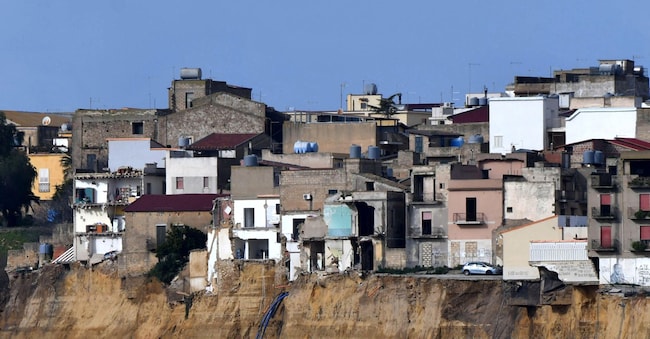
The four-kilometre-long rock fracture that split the hill at Niscemi in late January has brought to light a never-ending saga of administrative gridlock, in which even the funds earmarked for combating hydrogeological instability – approved as far back as the 1997 landslide – had become bogged down.
Prime Minister Giorgia Meloni has travelled to Sicily three times to ensure in person that the new funding for the projects (€75 million, supplemented by an equal amount for direct support to the population) would not suffer the same fate as their predecessors, thanks in part to the efforts of the Head of Civil Protection, Fabio Ciciliano, who has been appointed special commissioner. An investigation into past events has been launched by the Public Prosecutor’s Office in Gela, which in April entered 13 people into the register of suspects for culpable disaster, including the last four presidents of the Region Raffaele Lombardo, Rosario Crocetta, the current Minister for Civil Protection Nello Musumeci and the current governor Renato Schifani.
Spending figures
But there are thousands of towns like Niscemi – large and small – across Italia. Each has its own long-standing projects, and funding that is often announced with great fanfare following a disaster, only to get bogged down in the quagmire of unfulfilled promises.
The ‘Report on the territorial management of the prevention, mitigation and combating of hydrogeological instability’, published by the Court of Auditors (Resolution 14/2026 of the Autonomies Section), is a journey through the unfulfilled promises of the fight against landslides and floods. But it is also a treatise on the main ailment afflicting the Italian administration: the chaos of jurisdictional responsibilities.
As always, the figures are the first key to gauging the scale of the problem. In a convoluted compilation of the various official databases on the subject, carried out through ‘an integration of information significantly greater than that normally required for analyses of a similar nature’, as noted on page 215 of the report, the auditors examined 5,463 projects, 98.2 per cent of which were launched between 2018 and 2022.
These initiatives were allocated total funding of 3.174 billion: yet expenditure to date has stood at 1.31 billion, or 41.3 per cent, even though 90 per cent of the initiatives are at least five years old, and half of these have been running for seven or eight years.
Italia at risk
Such a performance does not sit well with the sense of urgency required for these measures, particularly in a country where 93 per cent of local authorities are at risk of flooding (19.3 per cent), landslides (16.2 per cent) or both (56.9 per cent). And there is no guarantee that the actual situation is not even worse.
This is because the magistrates themselves acknowledge that even their titanic efforts have not been sufficient to reconstruct the picture accurately. Even amongst the projects surveyed, the largest group (1,869 out of 5,463, or 34 per cent) is classified as ‘undefined’, meaning it does not specify the type of natural hazard it is designed to combat. 29.5 per cent of investment is directed towards landslide risks, and 27.7 per cent is aimed at preventing floods. There are only 44 projects to combat avalanches; these are the most costly (€1.9 million each, compared with an overall average of €581,000 per project) and also the slowest to complete, with expenditure standing at just 27.82%.
Institutional chaos
But the gaps in monitoring are merely a symptom of a wider range of management failings. Which, in the words of the Court of Auditors, ‘make it impossible to translate the decision into infrastructure projects’.
With governance of this sort, in short, the timely implementation of investments is not difficult. It is impossible. And the increase in funding – which has indeed taken place – is, at best, a futile political and administrative exercise. At worst, it is a waste of money.
Public funds, in fact, end up in a vicious cycle characterised, as the report explains, by the ‘coexistence of no fewer than seven different administrations involved in the decision-making process, each endowed with operational and spending autonomy that effectively renders coordination unfeasible (the Ministry of the Environment, the Ministry of the Interior, the Ministry of Agriculture, the Regions and Regional Presidents in their capacity as Special Commissioners for Reconstruction, River Basin Authorities, and local authorities)”.
The ‘numerous levels of institutional consultation, which are often mandatory (the conferences, ed.), contribute to prolonging the process’.
This gruelling marathon then falls to the implementing bodies, whose ‘limited technical expertise affects the quality of design, the feasibility of the works on site and, consequently, the ability to utilise available resources in a timely manner’: in an imbalance between regulatory bloat, institutional tangles and administrative shortcomings which, in Italia, is certainly not limited to the – albeit important – issue of hydrogeological instability.


