
Large hailstones: incidents up by 80% in Italia
Following the incidents at San Siro in Milan and on the A3 motorway, an analysis by the Radarmeteo-Hypermeteo centre. This is how the clash between warm and cold air triggers extreme weather events

Key points
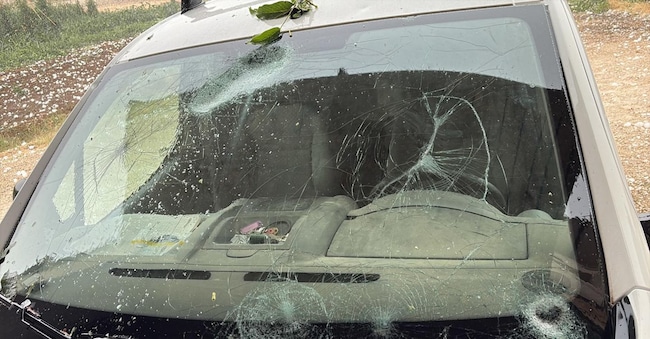
Two extremely severe hailstorms within the space of a few days, which could have had very serious consequences. Last Saturday in Milan, a violent hailstorm brought Bad Bunny’s concert to a halt and sent tens of thousands of people fleeing. On Wednesday morning on the A3, the motorway linking Bologna to Padua, a second extremely violent hailstorm caused extensive damage to cars, shattering windows and denting bodywork, but fortunately without any serious consequences for people.
Hailstones with a diameter of 5 cm are more common
“We must acknowledge the reality – as explained by Radarmeteo-Hypermeteo, a hub for reanalysis and applied climate scenarios founded by climatologist Massimo Crespi – that things have changed profoundly. The risk of large hailstones with a diameter exceeding 5 centimetres has increased by 80 per cent compared with the average over recent years. These new violent hailstorms should prompt us to reflect on how we manage outdoor events, because 80,000 people fleeing, as happened last Saturday at San Siro, can also become a public order issue.”
In Milan, warm air from the south meets cold air from northern Europe
“On Saturday,” commented climatologist Massimo Crespi, “a mass of warm, humid air was present over Lombardy, fuelled by the expansion of the African high-pressure system; at the same time, a weather system over Central Europe was beginning to push cooler, more unstable air towards northern Italia, creating a situation of stark contrast. At high altitude, stronger winds generated by this situation encouraged the formation of thunderstorms, whilst at ground level the accumulated energy could fuel even vigorous storm cells.”
In 2026, 13.5 per cent of the extreme events recorded over the last 10 years
According to the European Severe Weather Database, as reported by the National Association of Land Reclamation Consortia (ANBI), 7,526 episodes of ‘large hail’ have been recorded across the Italian Peninsula from 1 January 2016 to the present day: of these events recorded over ten years, as many as 13.4 per cent – that is, 1,006 – occurred in the first 7 months and 20 days of 2026.
This figure indicates a sharp increase in such events, given that there were 779 in 2025 as a whole, 687 in 2024, whilst 2023 was the year with the highest number of abnormal hailstorms, at 1,479; in 2022, 1,001 episodes of ‘large hail’ were recorded, compared with 871 in 2021. The further back in time one goes, the lower the number becomes.


