
Kartell's Grande Panda, a stylish exercise in innovation
Fiat-Kartell prototype unveiled. An arrival on the market after consolidation of the Turin-based brand's B-segment model is not excluded

3' min read
Key points
- A permanent laboratory to study fabrics and materials
- From the K101 ski rack for the Cinquecento to today
- New plastics and Tex-Tex for interiors in the future
3' min read
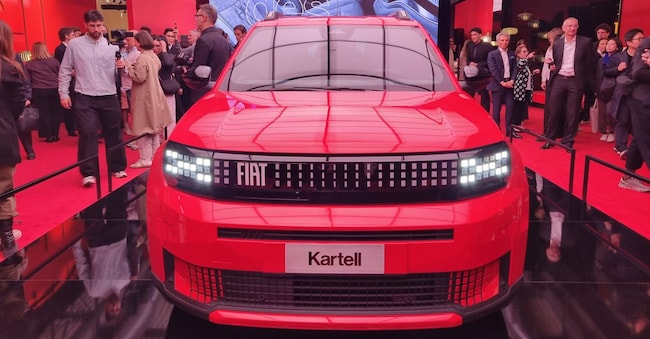
An exercise in style, but a successful one. The red Fiat Grande Panda bearing the Kartell logo makes its figure in the equally red stand at the Salone del Mobile of the Milanese design company, a leader in the use of polymers in design. For now, the new marriage between Fiat and Kartell is only aesthetic. There is no talk of a market launch. Although the two companies are not ruling it out a priori. Perhaps after the market consolidation of the Fiat Grande Panda, the model on which the Turin-based company is counting to make a breakthrough in the B segment.
But the Fiat Grande Panda Kartell workshop is an open workshop ready to produce innovations for furniture-design and automotive. In the tradition of a collaboration that began in 1949 with the production of the Kartell K101 ski rack by Carlo Barassi and Roberto Menghi (based on a Pirelli patent) for the first generation of the Fiat 500. A true creative workshop, where the style offices of the two companies have been meeting and mingling for some time, which also gave birth in 2000 to the Kartell 500e, one of the first forays of the Turin-based brand into electric car territory.
To the eye, Kartell's Fiat Grande Panda is a play on contrasts. The Kartell red and Tasmania Blue of the fabric interior produce an effect that floats between Pop art and psychedelia. The Kartell logo is in the wheels, made of recycled polypropylene, in the rear of the car and in the third pillar. In the passenger compartment, the 'k' logo stands out and the dashboard surprise is reminiscent of Kartell's iconic Kabuki lamp.
Fiat and Kartell promise more innovations. The Fiat Grande Panda Kartell laboratory is experimenting with the more extensive use in the automotive sector of polycarbonate 2.0, a second-generation polymer derived from renewable sources, appreciated by designers for its transparency, resistance and lightness. Polycarbonate 2.0, a symbol of Kartell's most iconic and sustainable products, could improve the aesthetics of cars and expand the use of innovative and sustainable materials for the two brands.
The contamination could also extend to other products that share a common production chain between the two companies. The Fiat-Kartell laboratory is working on a process called 'tex to tex': the fabric scraps of the Foliage armchair are reduced to waste fibres and then rewoven into a 100 per cent renewed polyester yarn, which can be used to upholster the seats with a central canvas composed of 60 per cent recycled polyester fabric. A process that reduces waste and transforms waste into high quality materials.


