
Plants speak and reconnect us to the time when we were one with the Earth
On 3 September, *The Silent Friend* is released in cinemas, starring a ginkgo tree alongside Seydoux and Leung Chiu-wai from *Lust*

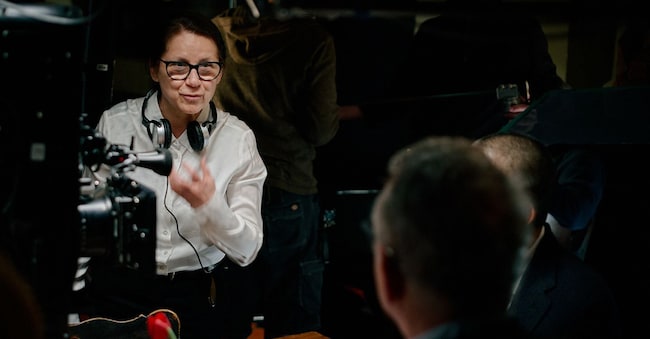
She says it herself: if Ildikó Enyedi were a plant, she would be a moss that grows in the woods and forms a layered carpet over the earth and rocks. Enyedi is a Hungarian film director, known amongst film buffs primarily for her creativity in capturing the invisible – the subtle connections that elude a rational interpretation of reality – in films where the protagonists are often marginalised or eccentric individuals who tackle difficulties through instinct, gut feeling, emotional openness to the unknown. She is set to become a director to watch and catch up on from 3 September, when her Silent Friend – which explores the interplay between neurology and plants – hits cinemas; a film that took the critics by storm at the last Venice Film Festival. Today, it could become a word-of-mouth hit – just as *Città di pianura* was, mutatis mutandis – for those interested in bridging the gap between the human and the plant world, and for the younger generations, who are keenly aware of the need to preserve the planet. Although this is not an environmentalist film, it is rather a reflection on the profound nature of plants and their interaction with humankind.
It is also a celebration of female strength, through characters such as Léa Seydoux (who also starred alongside Enyedi in *A Wife’s Story* , unfortunately a disappointing film) and Luna Wedler, playing the first German female student to be accepted onto a university science degree course, for which she won the Mastroianni Award for Best Young Actress.Seventy years old, yet carrying herself with the poise of a young girl – smiling, attentive to detail and to the sensibilities of those around her, as if she had a seismograph inside her – Enyedi began her career as a conceptual and multimedia artist and, within her quiet niche, has enjoyed a remarkable career as a director, one that revolves around Jungian synchronicity, significant coincidences and a touch of surrealism. Her first feature film, *My 20th Century*, won the Camera d’Or for best debut film at Cannes: it tells the story of twin girls born in Budapest at the end of the 19th century.
Having lost their parents at a very young age, they are separated; one becomes a femme fatale, the other an anarchist, and, without realising it, they both have a relationship with the same man. In *In Body and Soul*, a man and a woman who work in the same abattoir have the same dream without knowing each other. It is a highly complex psychoanalytical film about our connection with the animal world and the unconscious revealed through dreams. Winner of the Golden Bear in 2018, it made a lasting impression and won the Berlinale, despite being screened at the start of the festival – a slot usually reserved for blockbusters that get the audience going and for experimental films that aren’t quite polished. Plants are always lurking in Enyedi’s filmography: Magic Hunter chronicles the six-hundred-year life of an oak tree, Simon Mago, which won the Special Prize at Locarno, centres on a psychic from Budapest who arrives in Paris to help the police with a difficult case, which is ultimately solved by a potted plant. In all her films there is a magical element that the director weaves in almost as a challenge to the viewer. ‘We have hallucinations all the time; when we agree on our hallucinations, we call them “reality”’ is a quote, cited by Enyedi, from the neuroscientist Anil Seth (author of *How the Brain Creates Our Consciousness*, Cortina, 2023), which lends weight to the director’s theory. Hungary has repeatedly submitted Enyedi’s films for Oscar consideration, even during Viktor Orbán’s long tenure, although she has never identified with his policies. ‘I taught Theatre and Cinema at the University of Budapest until the university was stripped of its academic autonomy.’
In 2020, I resigned in protest against the Orbán government’s decision to impose a board of directors controlled by its political allies. I am now working with independent organisations because I love teaching so much – it has become an addiction. It’s not just a job; it’s about creating films together with passionate young people. I’ve had students from all over the world, from North America to Europe. They have very romantic ideas about art, artists and the role of the director in the 19th and 20th centuries, and I’m interested in understanding how these young people see things. They’re very serious film buffs; they follow experimental trends, which could be useful to them as future directors, but then it’s incredible how, as soon as they start school, their curiosity wanes and they stop keeping up to date as they did before – and I can’t explain it.’Whilst in *Body and Soul* Enyedi explored the separation and mysterious reconciliation between the physical and spiritual realms through the animal world, in *i* *Silent Friend* she continues this journey through the plant world. “Identifying a common thread is a necessity for critics to connect the dots, to create a theory that isn’t mine,” the director points out. “It’s simply that my films reflect my research, which is varied and, at times, recurring.”
The silent friend is a presence that revolves around the vastness of a loss, around the time when we were one with the Earth; a natural state for an animal, a plant and a newborn baby. We have unconscious memories of that time when we and the world were not separate, and there are rare moments when, as adults, we return to this certainty, sensing and experiencing this unity once more. It is a very powerful and deeply desirable experience. ‘This is the only point of connection between my latest film and the previous one: both revolve around ancestral memory.’ One of the film’s characters, Dr Wong, says: ‘We are part of an indistinct, continuous entity; the boundary between the visible and the invisible is fluid. It is not a question of boundaries or separation.’ In Silent Friend, the true protagonist—or rather, the true protagonist, as she is female—is a majestic, centuries-old ginkgo tree that stands at the heart of a botanical garden in a medieval university town in Germany. The ginkgo observes the lives of the people who try to make contact with it, in particular three characters of different ages and from different eras. We meet Tony Wong, a neuroscientist from Hong Kong, who studies children’s minds.


