Cars

Leapmotor B10 Reev Hybrid, how's the Chinese suv that only runs on electric power and fills up with petrol

Thanks to range extender technology, the Stellantis Group's Chinese SUV always runs on electric power but also recharges the battery via the THERMAL engine

by Simonluca Pini

4' min read

Translated by AI
Versione italiana

4' min read

Translated by AI
Versione italiana

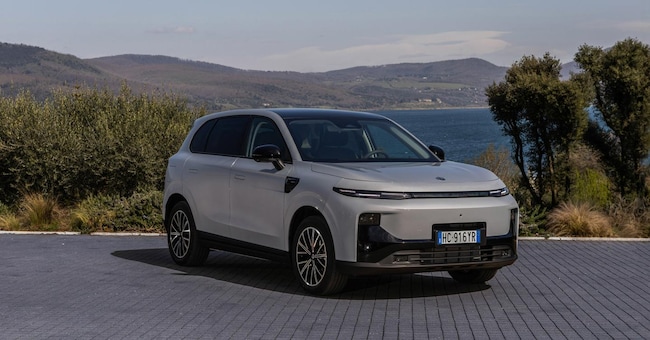
Travelling electrically but with the serenity of a fuel tank. This is the main added value of the Leapmotor B10 Reev hybrid, the range extender version of the Chinese SUV from the Stellantis group brand. The recipe is simple: take the electric version, fit it with a 1.5-litre four-cylinder engine, a 50-litre petrol tank and a smaller 18.8 kWh battery as opposed to the 56.2 or 67.1 kWh accumulator of the Bev version. All this with an electric car operating scheme, with the combustion engine used exclusively to charge the battery and not to provide traction to the wheels. The battery can also be recharged by cable, like all plug-in hybrid cars.

New Leapmotor B10 hybrid

Loading...

The dimensions of the Leapmotor B10 place it in the middle of the C-Suv segment, with a length of 4515 mm, a width of 1885 mm and a height of 1655 mm. The styling does not shine in terms of originality, as is very often the case with SUVs designed in China, and the rear is the least successful due to proportions that need to be revised and the strong resemblance to a premium German SUV no longer on sale in Europe.

Leapmotor B10 hybrid interior

Climbing aboard the B10 hybrid one finds oneself in the same environment already appreciated on the electric version, being 100% the same. Upgraded on the infotainment front (now with Apple CarPlay and Android Auto) thanks to the recent over-the-air update, they are convincing in terms of quality and build quality. The car's entertainment system and main functions are also praised, despite a few aspects to be reviewed such as the function that eliminates the navigator from the central screen when the arrow is put in to make room for the 360-degree video cameras with the car in transparency on the monitor; tried several times during the test drive, it adds no advantage on the safety side but, on the contrary, is distracting due to the temporary loss of navigation. Also noteworthy is the lack of a rear windscreen wiper, and overall the hope is that on future Leapmotor models there will be more on-board controls, such as air conditioning (a choice also indicated by the new Chinese rules) and controls for adjusting the mirrors.

There is plenty of space on board for the first and second rows, thanks to the flat floor, while the boot is more B-segment than C-segment. Only 330 litres in five-seat configuration; for comparison with a similar SUV in terms of external dimensions, the Volkswagen Tiguan plug-in claims a load capacity of 490 litres with the same configuration.

Leapmotor B10 Reev, how it works

A plus of the Leapmotor B10 Reev over the competition is the range extender technology used, where the electric motor with 218 horsepower and 240 Nm of maximum torque is the only one to provide traction to the wheels without recharging anxiety thanks to the power supply via a socket but above all thanks to the 1.5-litre four-cylinder heat engine used as a generator and fed by a 50-litre tank. This architecture results in an all-electric range of 86 kilometres and an overall range of around 900 km. It can be charged up to 6.6 kW in alternating current and 46 kW in direct current, while the 50 kW on-board generator recharges through braking and the combustion engine.

Leapmotor B10 Reev hybrid, le foto della prova su strada

Photogallery7 foto

Leamotor B10 hybrid, how it goes

Tested in an initial contact over about 100 kilometres on motorways, motorways and in an urban environment, the B10 Reev Hybrid convinced us by its range extender system operation. Starting with a fully charged battery, the best and recommended situation on all plug-in hybrids, the B10 Reev offers four different operating modes - Ev+, Ev, Fuel and Power+. Two of these modes are purely electric - Ev and Ev+ - and operate with the engine completely switched off, ensuring zero tailpipe emissions and offering a fully electric driving experience for urban use and daily commuting.

The other two modes - Fuel for maximum autonomy and Power+ for maximum power - activate the on-board generator, providing additional energy when more autonomy is required, more power is needed or in specific driving conditions.

Its strong point is its smoothness of use, even in thermal engine operating modes, and the recent Ota update added a one pedal driving function (where you just lift your foot off the accelerator for more braking and regenerative force) that is ideal in an urban environment. Steering and set-up reflect the character of a family SUV, with a calibration that favours comfort over driving precision and roll control. Consumption is low even with a flat battery, not too far from the 6.1 litres per 100 km declared by the Chinese manufacturer.

Leapmotor B10 hybrid, what it costs

Further added value comes in the price, because the B10 Reev Hybrid is on sale for around 30,000 euro for the Life trim and 31,400 euro for the Design, the protagonist of our test. Figures to which we have to add 1,100 euro for road preparation and 650 euro for optional colours. The equipment is already complete in the access version, including 17 adas, the entire infotainment compartment, 18-inch alloy wheels and 360-degree camera. The Design adds electric tailgate and electric, ventilated and heated front seats as accessories.

Copyright reserved ©
Loading...

Brand connect

Loading...

Newsletter

Notizie e approfondimenti sugli avvenimenti politici, economici e finanziari.

Iscriviti