Test drive

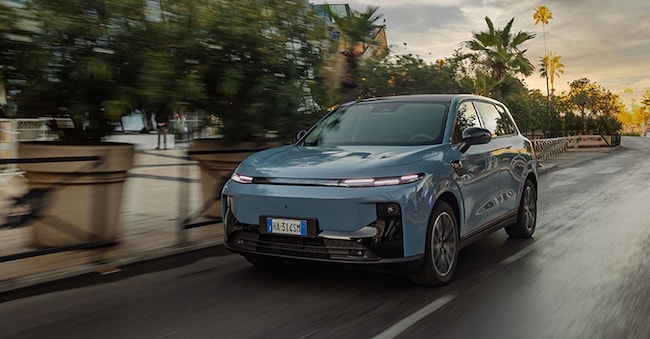
Leapmotor B10, the road test of the Stellantis Group's Chinese electric suv

Available in two trims and with two battery sizes for a maximum range of over 400 kilometres.
by Giulia Paganoni

3' min read

Translated by AI
Versione italiana

3' min read

Translated by AI
Versione italiana

Large capacity battery, more than enough autonomy so as not to feel anxious while travelling: all this with compact dimensions but adequate space on board. This is the B10, the electric suv by Leapmotor, a Chinese brand that is part of the Stellantis group. We tested it in Nice (France), along the Côte d'Azur on a mixed and scenic route. The star of the test was the 67.1 kWh ProMax version (a smartphone name), which allows you to run up to 434 km. For the Italian market, the price is around 30,000 euros

Leapmotor B10, size and comfort for five

Built on the Leap3.5 platform, the B10 SUV is the Chinese brand's first model to be designed for international markets and integrates cutting-edge technology, smart connectivity and a user-centred design philosophy.

Loading...

The dimensions are compact: 4,515 mm in length, 1,885 mm in width and 1,655 mm in height. The Leapmotor B10 is an SUV suitable for urban use, but without sacrificing the spaciousness needed for travel and practicality thanks to 22 storage compartments. Even second-row passengers have enough space for their knees, thanks to the 2,735 mm wheelbase and flat floor. The boot capacity is also in line with competitors in the segment: 430 litres and can be up to 1,300 litres.

Leapmotor B10, almost European style and hi-tech interior

The exterior is characterised by a simple style reminiscent of other models already on the market, with clean, essential lines.

There are two versions available: the Life version, which includes a panoramic glass roof with electric sunshade, 18-inch alloy wheels, 360° parking camera and a complete Adas package; and the Design version, which adds pleasantly soft and comfortable eco-leather seats, ambient lighting and heated, ventilated and electrically adjustable front seats. The interior is strongly reminiscent of Tesla styling and some Volvo details. The controls are completely touch except for the steering wheel controls, also strongly inspired by Tesla and the Geely (Volvo/Polestar) world.

In both versions, a 14.6-inch touchscreen is already standard, acting as the hub for infotainment and the management of on-board functions. The decision to make the 8.8-inch digital dashboard integral with the steering column is a peculiar one, so that when the steering wheel is moved closer and further away, the display also moves to ensure maximum visibility at all times.

Leapmotor B10, on-board technology and safety

The maps are clear and are provided by Huawei's Pedal Maps, and it should be noted that Leapmotor and Huawei have signed a collaboration to develop a native HarmonyOS Next-based app for the Chinese brand's vehicles.

On the safety side, however, Leapmotor relied on Qualcomm by adopting the 8155 microprocessor platform, developed for use in next-generation vehicles. There are 17 on-board Adas functions, a 360° camera system and a high-strength steel safety cage. The Leapmotor B10 aims for a five-star E-Ncap rating and benefits from Stellantis-designed chassis tuning, multi-link rear suspension and 50:50 weight distribution for precise handling.

The car opens and closes with an NFC smart card, very similar to Tesla, which is placed on the rear-view mirror, an unfortunate position and exposed to bumps. In any case, there is also an app for using the smartphone

Leapmotor B10, engine range: over 400 km of autonomy

Only one engine is available with 218 cve 240 Nm of torque, capable of covering 0-100 km/h in 8 seconds, and the power of the electric motor allows a top speed of 170 km/h. Two battery options are available: the 56.2 kWh Pro version offering up to 361 km of autonomy (Wltp cycle) and the 67.1 kWh ProMax battery version delivering up to 434 km. Both batteries support 11 kW AC charging and ultra-fast DC charging up to 168 kW, allowing a 30-80% charge in less than 20 minutes. The consumption figures recorded during the test drive along a mixed route were 10.9 kWh/100 km.

Copyright reserved ©
Loading...

Brand connect

Loading...

Newsletter

Notizie e approfondimenti sugli avvenimenti politici, economici e finanziari.

Iscriviti