
Lee Miller: the perennial modernity of an icon
The exhibition curated by Hilary Floe and Saskia Flower is at the Tate Britain in London, until 15 February 2026

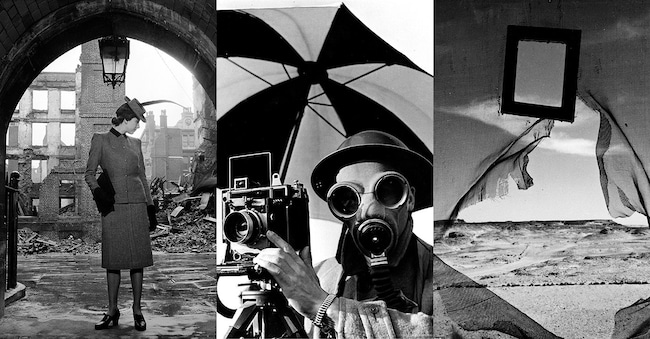
Looking at Lee Miller's photographs today means confronting issues that are still dramatically topical: war, trauma, memory, the right to narrate. But it also means rediscovering a model of strong, independent, creative femininity. It means celebrating a woman who - despite having gone through horrors and suffering - never stopped transforming experience into image, life into a glance, devastation into testimony. The exhibition at Tate Britain restores this significance: not only as a historical document, but as a manifestation of a modernity that continues to speak.
Lee Miller One, None, One Hundred Thousand
The retrospective that Tate Britain is dedicating to Lee Miller marks a decisive moment in the reinterpretation of the American artist, finally restoring to her the complexity and radicality that for decades remained in the shadows. The wide-ranging and surprising exhibition reconstructs not only the career of a photographer with a prodigious visual intelligence, but also the path of a woman who spanned the 20th century, transforming every experience-private, political, artistic-into living material for her research.
Experimentation with the photographic medium
The exhibition opens with the Parisian years, when Miller, in her early twenties, went from being a muse for fashion magazines to experimenting with photography with a freedom that still seems shameless today. The solarisations, the tonal inversions, the shots that decompose the body into luminous fragments: everything speaks of a modernity that does not allow itself to be tamed. There is no aesthetic complacency, but an urgency to question the image, to make it a gateway to the unconscious, to dismantle the traditional vision of the feminine with a technical gesture that is already political.
Archive rewriting, memory rewriting
One of the strengths of the exhibition is the emergence of the unpublished: photographs that had remained in private archives for years, travelogues, visual notes, specimens that had never found a place in official narratives. It is here that the researcher Miller reveals herself in all her breadth.
Travels, deserts, remote spaces: a transnational vision
The shots taken in Egypt, in the desert or along little-known routes, show a surprising attention to the geometries of the landscape, to the relationship between light and space, to that suspension that anticipates contemporary sensibilities. They are images that radically expand the imagery associated with the artist, adding a contemplative and almost metaphysical dimension.

