
Lefebvrian schism: four bishops consecrated
Father Pagliarani’s homily: ‘Ready to pay any price’

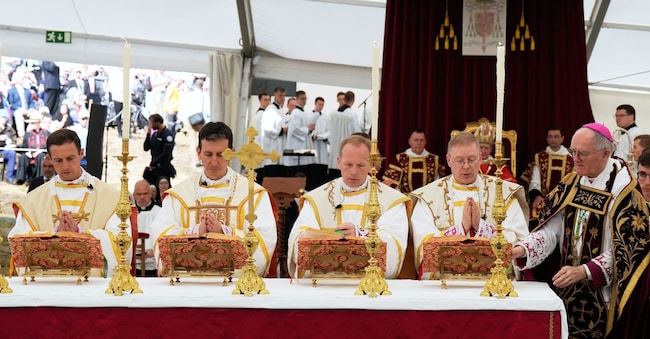
The Lefebvrians have stood their ground. At Ecône, in Switzerland, four new bishops were consecrated, despite having ignored the Pope’s call to halt the proceedings. This act entails automatic excommunication and, consequently, schism from the Catholic Church. A formal statement from the Vatican could be issued as early as today or, at any rate, within the next few days. The first act of the actual consecration was the laying on of hands on the heads of the new bishops by the celebrant, Monsignor Alfonso de Galarreta, and by Monsignor Bernard Fellay, the co-consecrator. Further liturgical gestures will follow.
It had already happened once before, exactly 38 years ago. On 30 June 1988, Marcel Lefebvre consecrated four bishops without the authorisation of John Paul II. In the days that followed, the Holy See declared the excommunication of Lefebvre, the co-consecrating bishop Antonio de Castro Mayer and the four new bishops at the time: Bernard Fellay, Bernard Tissier de Mallerais, Richard Williamson and Alfonso de Galarreta. John Paul II spoke of ‘an act of disobedience’ and described it as a ‘schismatic act’. The vestments worn by the four new bishops are the same as those used in 1988 for the previous consecration that led to the first schism, which was subsequently resolved by Benedict XVI’s decision to lift the excommunication.
‘We are accused of not loving the Pope; we are accused of not respecting him – but it is precisely because we love the Pope as the Vicar of Christ’ that we ‘no longer wish to see the Pope humiliated, placed on the same level as false shepherds’, said the Superior of the Society of Saint Pius X of the Lefebvrian Christianity, Fr Davide Pagliarani, in his homily during Mass.
“How many times have we seen the Pope in this situation? Precisely because we love the Vicar of Christ, we do not want this humiliation to befall the whole Church, which is being placed on the same level as false religions,” added the head of the Lefebvrians.
‘Why aren’t we understood? The problem is that we speak two different languages. We speak the language of faith, the language of tradition’ and ‘we are faced with a language that speaks of other things: the language of inclusion, dialogue and accompaniment. We, on the other hand, want faith. Then, of course, within our faith we engage in dialogue with people in order to convert them,’ emphasised Father Pagliarani.

