
Legambiente: 80% of waste in parks and beaches is plastic
Review four years after the transposition of the Sup Directive banning certain single-use products

Key points
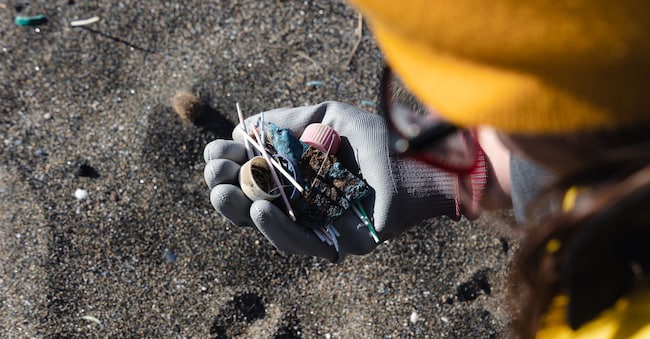
Waste in the environment, the majority is plastic. Four years after the transposition of the European Sup (single use plastics) directive, which bans the trade of certain single-use plastic products - such as crockery, straws, balloon poles -, the material continues to be the most found on beaches and urban parks. This is certified by the study by Legambiente Beach and Park Litter, the result of the first monitoring in beaches and parks, on a national scale, and with a differentiation for bioplastics, carried out with the collaboration of the Chemistry Department of the Sapienza University of Rome. Out of 40,388 occurrences of waste collected by the environmental association from 2021 to 2024 in 10 beaches and 10 urban parks in Italy, 80 per cent consisted of traditional plastic, in the form of packaging and disposable objects. Among those most frequently found: caps (with plastic beverage lids the most frequent: 4.4% of the total) disposable bags, bottles and glasses.
Bioplastiche
In addition to plastics, metal (6.8%), paper and cardboard (5.9%), glass and ceramics (3.6%), rubber (1.3%), clothing and textiles (1.1%), wood (0.5%), food waste (0.3%), mixed material waste (0.2%) and, finally, in compostable and biodegradable bioplastics (0.2%), a material that is still not included in the official monitoring protocols and that is not part of the list that is used at European level, the association reports. "Bioplastics could have become a new emergency with the spread of shopping bags and tableware, in reality the data show a very low presence, due to the greater difficulty in dispersing them, and the possibility of disposing of them with organic waste," explains Legambiente's scientific manager Andrea Minutolo.
"We see," he adds, "a drag factor, runoff, which leads to a difference between parks and beaches. In the latter, more plastics are collected, i.e. more transportable and resistant objects. That is why the Sup originally acted on plastic objects ending up in the sea'. The persistence in the environment has led to the discovery of old waste, even dating back to years before Sup, such as cotton buds, banned in Italy from 2019.
Spiagge
Of the 40,388 waste items monitored in the study by Legambiente, 34.1% were collected in urban parks and 65.9% on beaches. In the latter's waste, 90.5% was found to consist of traditional polymers against 0.2% of compostable and biodegradable bioplastics. In parks, the share of traditional plastics drops to 58.2%, while the 0.2% of bioplastics remains constant, to which we must add important percentages of metals (15.4%), paper and cardboard (13.6%) and glass and ceramics (7.2%). Legambiente points out that from 2021 to 2024, 108 monitoring sessions were carried out, divided into 6 periods (3 in spring-summer and 3 in autumn-winter).
Sup
"With this study we want to bring attention back to the issue of waste dispersed in the environment, starting with traditional plastic waste, but not only. It is mostly single-use waste, which is among the primary causes of littering," comments Giorgio Zampetti, director of Legambiente. "Pollution from littering," he stresses, "continues to remain a constant emergency in Italy and a threat to biodiversity, the environment and ecosystems, despite the transposition of the European Sup directive. It is important for Italy to commit to reducing plastic waste by applying Sup, but also by closing the regulatory vulnus created by the lack of definition of 'reusable' in the directive and in the transposing decree 196/2021. A request that we are raising again today also at the European level, given that consultations on the updating of the Sup itself have opened these days". The lack of definition has resulted in reusable virgin plastic products returning to supermarket shelves, but in fact treated as disposable.


