Digital

Artificial intelligence in every notebook. Here's what's new from Lenovo

Partnership with Formula 1 from 2025 also announced at Ifa Berlin. And Ai amplifies the 'senses' of devices

by Giancarlo Calzetta

4' min read

4' min read

We are in Berlin, where the IT industry is gathering to participate in Ifa (the big European technology fair that takes place from 6 to 10 September) and Lenovo has taken advantage of the previous day to launch its new AI Pcs, high-end products that give us an idea of how pervasive artificial intelligence will be in the coming years, and its partnership with Formula 1 that will see it become a Global Partner of Formula 1 from 2025.

Ai PCs, the computers based on new chips designed to use artificial intelligence without an Internet connection, are certainly not new. They have been talked about for some time and the first models have already been around for a few months, but the public is still somewhat confused about their use. This is why manufacturers are looking for a way to show what they can do at a time when software that exploits the capabilities of the new chips is really scarce.

Loading...

Le novità di Lenovo a Ifa 2024

Photogallery27 foto

Intel, Amd and Qualcomm provide the engines for AI

.

On the end-consumer side, the product lines differ mainly in terms of the platform used: Intel, Amd and Qualcomm, with the latter playing the role of the newcomer, but which has given the industry a wake-up call with its strongly energy-saving and AI-oriented architecture.

Lenovo has tried to give each platform a specific identity, working with vendors to offer something to differentiate its proposition from that of other manufacturers.

The most advanced and comprehensive AI integration is probably found on the Lenovo Yoga Slim 7i Aura Edition (15", 9), a Copilot+ PC1 Intel® Evo™ Edition with Intel Core™ Ultra (Series 2) processors. For the Aura series, created together with Intel, a number of advanced features such as Smart Mode and Smart Share have been developed and introduced. The former includes four specific functions ranging from Attention Mode, in which non-essential notifications and distractions in general are blocked, to the Wellness Functionality, in which the AI uses the webcam to analyse the user's posture and correct any incorrect posture or behaviour. In between is Shield Mode, in which the webcam detects if someone is spying on our screen from behind and Vpn is activated to improve the security posture of data in transit, and Collaboration Tools, which deal with optimising calls, improving the brightness of the webcam image, blurring the background and so on.

Smart Share, on the other hand, opens a window on the PC that gives access to photos and videos on the smartphone, making it easy and straightforward to transfer files.

The most interesting thing for those involved in technology is that the work of AI in these functions is not overt, but works 'behind the scenes' to provide functions that make using the device more convenient.

Ai multiplies computer senses and functions

.

Thanks to Ai, in fact, it is possible to use the few sensors on notebooks to activate functions that seem to be based on 'senses' that do not actually exist. For example, we said that Smart Share activates a window when you touch the edge of the PC screen with your smartphone, but neither the PC nor the smartphone has a proximity sensor on the edge. The Ai, however, combines the accelerometer readings and by synchronising the data between the PC and the phone, it knows when the two are touching. Similarly, the webcam is used to monitor our posture, but also to manage resources more intelligently. Thanks to Npu's (the neural processing units typical of Ai Pcs), we will soon have computers that will lower the brightness of the screen when the user turns their head in another direction, saving energy. The topic of 'virtual sensors' is an important topic that allows for an incredible expansion of the capabilities of devices that in the past would have needed hardware dedicated to special functions.

Intelligent multitasking and power management

.

The Lenovo Yoga Pro 7 (14-inch 9) is based on the Amd Ryzen AI 9 365 processor and on paper is expected to provide the most power in AI applications and is especially targeted at creative workflows. The X Power Software Accelerate function harnesses AI to accelerate the creation and display of previews, rendering and file exports. The X Power Hardware Boost function, on the other hand, manages the chips' power consumption and power output to keep the notebook cool and pleasant to use even during long sessions.

AI is no longer just for very inflated wallets

.

The new IdeaPad line-up includes the Lenovo IdeaPad 5x 2-in-1 and the Lenovo IdeaPad Slim 5x that are based on the 8-core Snapdragon X Plus processor, designed to bring AI features to computers costing less than a thousand euros.

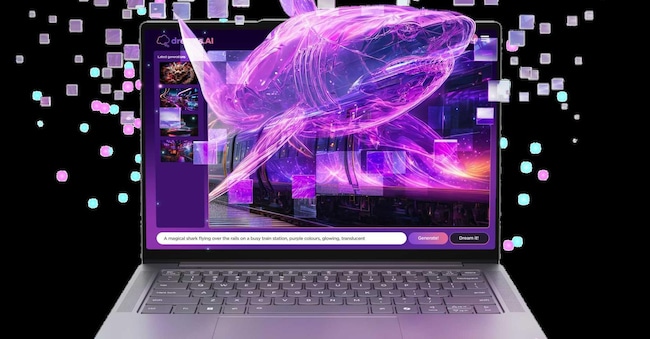
While most of the functions we have seen so far work automatically and without the user knowing what is going on, Lenovo has also decided to release from October Lenovo Creative Zone, an application initially only for the Yoga Pro 9i that can be downloaded from the company's website that allows users to create images from a textual description, complex illustrations from simple pencil or digital sketches, illustrations from images and textual instructions, and finally, consistent editing of images with very little effort. In this way, the power of generative AI becomes evident and adds a very convenient tool to start familiarising oneself with the new tools that will become common leisure and work tools in the coming years.

Ai also enters corporate notebooks

.

In the area of business computers, Lenovo has also introduced all the AI-based innovations we have seen in the consumer side.

Lenovo announced the new ThinkPad™ X1 Carbon Gen 13 Aura Edition, powered by Intel® Core™ Ultra (Series 2) processors, the ThinkPad T14s Gen 6 and ThinkBook™ 16 Gen 7+ powered by AMD Ryzen™ AI processors. In addition, Lenovo introduced the ThinkBook 16 Gen 7 powered by the 8-core Snapdragon® X Plus processor. Also announced was the AI PC Fast Start initiative, a solution designed to help organisations quickly transition to AI-ready devices by maximising Roi, designed for individual devices and entire "fleets" of PCs.

"We are committed to pushing the boundaries of innovation and bringing AI-based technology to all," said Luca Rossi, president of Lenovo's Intelligent Devices Group. "Our new Ai Pcs, including the innovative Aura Edition series, represent a significant step forward in delivering highly personalised, productive computing experiences in a secure environment.

Copyright reserved ©
Loading...

Brand connect

Loading...

Newsletter

Notizie e approfondimenti sugli avvenimenti politici, economici e finanziari.

Iscriviti