
Leonardo leads the supply of helicopters to support the energy industry
In this specific activity, the group is present with around 500 aircraft worldwide out of a total fleet of 4,500 vehicles

4' min read
Key points
4' min read
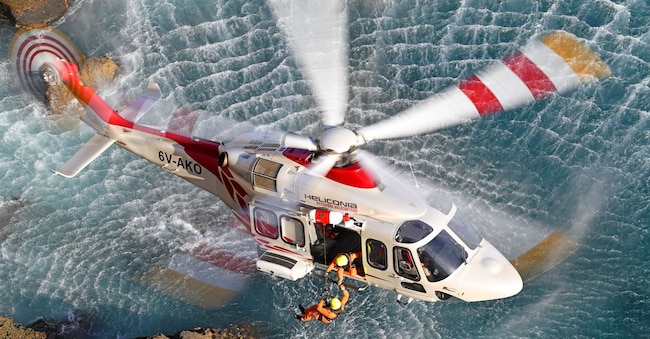
Among Leonardo's records there is one that is little known to the general public, but is recognised and highly appreciated by those in the industry: offshore (offshore) helicopter transport in support of the energy industry and search and rescue at sea. In particular, every two minutes a Leonardo helicopter takes off around the world to carry out missions related to offshore energy activity.
Leonardo is the world leader in this specific market segment with a fleet of almost 500 helicopters worldwide dedicated to offshore transport (out of a total fleet of 4,500 helicopters in service on five continents for all operational applications: helicopter rescue, firefighting, private transport and others). Since 2015, Leonardo has been the leader in offshore helicopter deliveries by value, a peak reached in 2023 with a 75 per cent share. The company expects to maintain this positioning over the next five years in response to expanding market demand. Moreover, almost 30 per cent of the flight hours accumulated in a year by Leonardo's helicopters are achieved for offshore operations. But let us go in order.
A booming sector
.The energy industry sector active in the maritime environment is booming. Over the next five years, the number of infrastructures at sea is set to grow and to be increasingly diversified between short and long distances from the coast, driven by Oil & Gas (oil and methane exploration and extraction) and wind power (in the area of renewable energy sources). This trend involves all the main markets and geographical areas in the Oil&Gas sector, while in the case of wind energy it is mainly Northern Europe, but also, progressively, North America and Asia.
Consequently, helicopter transport and assistance services will play a central role in supporting the energy business. In particular, we are talking about: transport of specialised personnel and materials to and from platforms; transport of maintenance technicians for technical assistance; inspections and repairs of wind farms (transfer of personnel to or from individual turbines by winch in stationary flight, in different weather and environmental conditions, with greater effectiveness and efficiency than the use of boats, as the helicopter is faster and more flexible and can do more work in a single day or on a single mission) search and rescue missions of personnel both at oil platforms and in the areas where the wind farms themselves are located; transport of personnel to or from large oil tankers connecting them to ports.
This specific helicopter market, which is recovering strongly after the acute phase of Covid, is growing significantly to meet the needs of these services dictated by the energy sector. There is a demand for: more modern products capable of covering long distances with more flights per day and able to meet more stringent operational, efficiency and safety standards (both with aviation authorities and national institutions as well as with large energy players); increasingly qualified and trained pilots and technicians; greater sustainability: from production processes to digital technologies to the use of Saf biofuel. In this scenario, digital and space technologies (satellite navigation) play a crucial role. One example is the collection of in-service fleet data to assess how best to manage maintenance, service, training and product optimisation for the benefit of the end user. What is collected in the offshore market, typically the one where most helicopters are flown, becomes an optimisation driver for all products and services in each of the company's helicopter markets and therefore increases its competitive advantage.


