
Leone addresses Europe and refers to the “pointless carnage” of wars
Speech in Metz, Schuman’s hometown, on the final day of the trip to France

Key points
Leo XIV speaks of peace in the heart of Europe, and recalls the words of one of his predecessors, Benedict XV, during the Great War: ‘The pursuit of peace in Europe, as in the rest of the world, must not be confused with a naïve irenicism’. The Pope said this whilst issuing a warning: ‘We must guard against the illusion of rearmament.’ For Leo XIV, ‘promoting peace is an active endeavour. Today we must ask ourselves whether we are truly making ‘creative efforts’ to promote world peace, or whether we are simply trying to stem the tide of war and better prepare ourselves for those conflicts we assume are yet to come. Unfortunately, war has reappeared today, even in Europe: a new ‘pointless slaughter’, which claims countless civilian victims every day’.
‘Today, relations between people and between states are becoming increasingly barbaric’
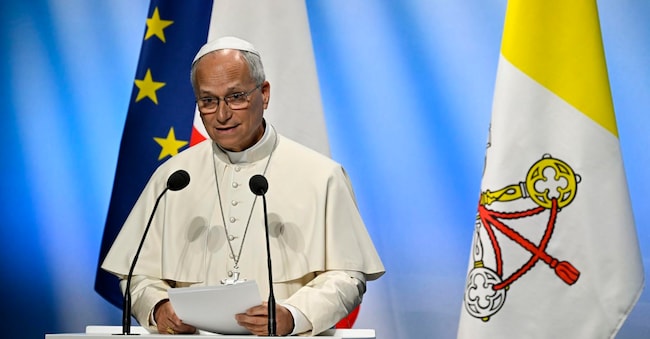
Leone speaks in Metz, the birthplace of Schuman, one of the founding fathers of Europe, on the final day of his trip to France. ‘International law and multilateralism emphasise the effective equality of states in their mutual relations and constitute the best antidote to the desire for domination, which lies at the root of every conflict. Today, relations between people and between states are becoming increasingly barbaric. The value of one’s word is scorned; instead, people pride themselves on lies and deceit.’ He added that ‘Europe can put an end to this downward spiral thanks to the respect for others that it has managed to cultivate and preserve’.
‘Integrate migrants and help them develop their talents’
Furthermore, contemporary Europe ‘is facing a new chapter in its long history of encounters, with the arrival on the continent of so many men and women fleeing theatres of war and persecution, or seeking a better life away from poverty and destitution’, said the Pope, emphasising that ‘welcoming a person means integrating them as if into one’s own family, offering them the opportunity to develop their talents, abilities and sensibilities, but also to enter into the spirit of the home that welcomes them’. Leo XIV calls on us to ‘grasp the historic significance of what is happening, namely an unprecedented encounter between peoples and cultures which calls for a creative rediscovery of our roots and, at the same time, for us to listen attentively to one another. The universality of Europe’s founding values assures us that this dialogue is possible and that it can provide a solid foundation for our societies, enabling us to work more effectively for peace and a reconciled world’.
Europe should look to its Christian roots
Leone went on to add that Europe must look to its Christian roots because ‘one cannot speak of Europe without mentioning Christianity’, as the Pope said in his address in Metz, quoting Robert Schuman and Alcide De Gasperi. But ‘to understand this long history, however, one cannot fail to mention another Father of Europe: Saint Benedict, whom the holy Pope Paul VI proclaimed patron of Europe in 1964, describing him as “a messenger of peace, a builder of unity, a teacher of civilisation”’. For the American Pope, ‘the reference to European culture’s debt to Christianity enables us to understand better how openness to the transcendent is always a constitutive dimension of the human person and a living source of civilisation’. Therefore, “the secularism that governs the life of states does not merely imply the non-denominational character of civil institutions, but presupposes genuine collaboration between the parties, as well as respect, on the part of state and community authorities, for the autonomy of the Churches and the promotion of their freedom of organisation, expression and worship”.


