
Lessons in Love According to Renoir
An exhibition at the Musée d’Orsay in Paris explores the more intimate and sentimental side of the famous Impressionist master

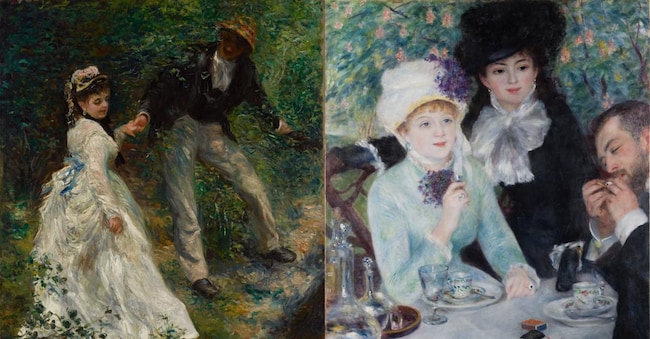
Love, the most universal of all emotions. Glorified, scorned, revered, lost or coveted, it remains a fascinating human illusion.
The Musée d’Orsay’s temporary exhibition, dedicated to Auguste Renoir, conveys this much-praised emotion with meticulous mastery of light and colour. The exhibition brings together for the first time a significant body of works depicting scenes from modern life, created by Renoir during the first twenty years of his career (1865–1885).
Painter of Happiness
A painter of happiness, during this period he decided to focus on contemporary subjects rather than landscapes and portraits, set against a backdrop of joyful and convivial atmospheres, from Parisian cafés to public dances: “I know full well that it is difficult to convince people that a painting can be truly great whilst remaining joyful”. There is, therefore, no room for sadness or melancholy, but rather lucid brushstrokes centred on empathy and wonder. Splendid examples of this can be found in the early works of the exhibition, such as ‘Le Garçon au chat’ (1868), in which a naked boy embraces his cat, evoking the pose of Parmigianino’s Cupid, or ‘La Promenade’ (1870), a new attempt at depicting a couple, in which the woman holds her partner’s hand amidst the foliage of the trees, brought to life by skilful brushstrokes. Renoir deepened his artistic exploration between 1874 and 1877, whilst taking part in the Impressionist group’s exhibitions. A fine example of this period is *Confidences*, in which the couple’s bodies merge into a single form, their gaze fixed on the same newspaper: a vision of respectful and intimate love, far removed from any hint of mischief. He painted mainly in Montmartre, at the time a suburb of Paris, having friends and models pose in his own garden or at the Moulin de la Galette, a well-known dance hall which inspired his painting created en plein air. The work presents a challenge both in terms of the study of light and composition, given the huge number of figures in the scene. Thanks to his fluid brushwork, his range of bluish tones and his use of enveloping, harmonious gestures, the artist succeeds in imparting a strong sense of pictorial and social unity to the whole. Renoir takes particular pleasure in depicting the happy bonds between men and women, the middle classes and the working class, eliminating any hint of possible power dynamics between the sexes or social discrimination. In reality, in fact, young people from affluent backgrounds frequented that venue to enjoy themselves alongside female workers from the working classes, who often saw these encounters as an opportunity for social advancement.
Freedom and equality in romantic relationships
He thus celebrates freedom and equality in romantic relationships and a form of ‘camaraderie’ (as his friend Rivière described it), that is, a relationship based on mutual friendship between men and women. In this way, he revives the spirit of the fêtes galantes of Watteau and Fragonard, artists whom he deeply admires. This took place at a time when French society, still struggling to recover from the trauma of the 1870 defeat and the civil war of the Paris Commune, was deeply marked by social divisions, tensions and violence. Through his light brushstrokes and vibrant colours, Renoir celebrates the common people, their ability to withstand hardship and their sociability – the latter often criticised by the dominant bourgeois morality. Also on display is ‘Le Déjeuner des Canotiers’ (1881), a colourful slice of life depicting the leisurely post-lunch atmosphere of a Sunday on the Seine in the city. The colours in the work blend harmoniously, drawing the viewer into the scene, which features intellectuals and journalists who were friends of Renoir.

