
'Let's hold the cards like love notes': tomorrow 80 years ago
Paola Cortellesi's beautiful film 'There's Still Tomorrow' closes with the touching first time women at the ballot box

Key points
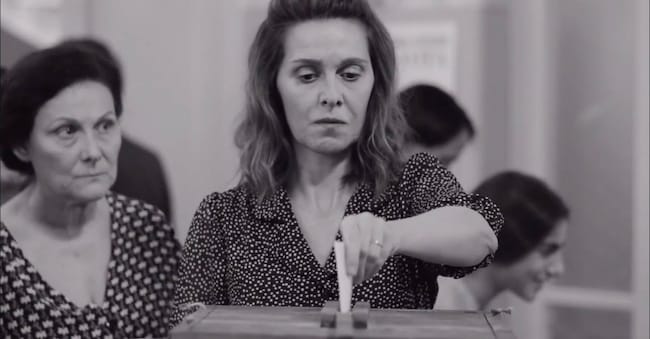
"We clench the ballot papers like love notes", this is how Paola Cortellesi's film C'è ancora domani ends, taking up a quotation from the writings of the journalist Anna Garofalo, who thus stigmatised the 'first time' of Italians at the ballot box, the conquest of universal suffrage. Paola Cortellesi's film plays until the end of the screenplay on the ambiguity that Garofalo's phrase suggests. Delia, called De', played by Cortellesi herself, seems to want to escape her abusive husband by running away with another man. And, instead, redemption for Delia passes through independence, the highest expression of which is being able to decide the fate of the country, to influence everyday life through voting.
The film's public and critical strength
It was a film that awakened a very large female audience, and not only female of course. It scored over 5.5 million admissions (about 5,520,000 tickets sold in Italia), grossing more than EUR 36.6 million at the domestic box office and exceeding USD 50 million globally. It was loved by critics, winning no less than 6 David di Donatello, 20 Nastri d'Argento and a Golden Globe, as well as prestigious international awards such as Best Film at the Golden Rooster Awards in China. It is one of the few Italian films to have penetrated the Chinese film market.
The plot and black and white
Paola Cortellesi shoots and stars in a film that is surprising in terms of plot and direction, telling the story of a Roman mother of a family, who in the post-war period weaves the underground resistance of women in the first universal suffrage. The fact that Cortellesi's directorial debut was not just a whim is already clear from the choice of black and white: something to make the producers put their hands in their hair. Few have managed to get away with it in recent years: Michel Hazanavicius with The Artist in 2011, Paweł Pawlikowski with Ida in 2013 and in the same year Alexander Payne with Nebraska.
Urgence, rhythm and substance
It takes urgency, pace and substance to survive 'faded' in the world of the big screen with its stroboscopic special effects. And There's Still Tomorrow has all these qualities, plus Davide Leoni's excellent cinematography that illuminates Delia's life. De' every day tidies up her basement in Rome's Testaccio district, then fixes umbrellas, punches other people's houses, washes gentlemen's laundry. We are in the mid-1940s and there is nothing tragic in this race for survival, neither in the dog urinating on her pots to the tune of Fiorella Bini's song Aprite le finestre (Open the windows), nor in the morning slap that her husband Ivano, known as Iva' (Valerio Mastandrea) gives her as a daily 'cure'. Like many abused women, De' dreams of a love less brutal than the one she broods over at home, where slaps and blows fly just to let off steam. And she yearns for a youthful passion, Nino (Vinicio Marchioni), who could have been the one and was not.
The script
Herein lies the film's keystone, with the screenplay written by Cortellesi herself, Furio Andreotti and Giulia Calenda, reserving always surprising plot twists, with the feet firmly planted on the ground of the women who cash in by weaving a form of underground sororal resistance, much more astute than others expect, in anticipation of a gender equality that takes its first steps with the referendum of 2 June 1946. It is a sublime practical intelligence that guides De' to turn the destiny of his daughter Marcella (Romana Maggiora Vergano) upside down, diverting her from a future as a housewife written in custom.


