The debate

Letta: 'For Europe it is time for independence'. Marcegaglia: energy autonomy is needed

The former prime minister: the Old Continent must overcome its weaknesses. Marcegaglia: enterprise needs energy autonomy

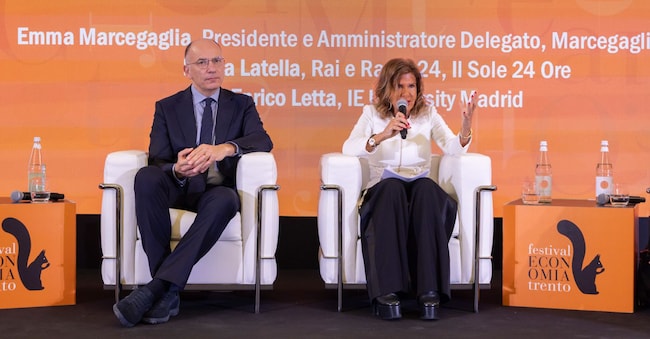
Luca Benecchi

Una Europa, un mercato
Nella foto: Enrico Letta, Emma Marcegaglia

5' min read

Translated by AI
Versione italiana

5' min read

Translated by AI
Versione italiana

"The turning point? The Greenland affair and Trump's attempt to annex it to the United States. This has made the Northern European countries completely change their approach. Rarely has there been such an interesting moment in European life, where there is a very strong desire for independence, autonomy and integration'.

This is how Enrico Letta began his speech in the dialogue with Emma Marcegaglia, moderated by Maria Latella, at the Economy Festival in Trento.

Loading...

"You will hear me repeat the word independence many times. In my opinion,' continued Enrico Letta, 'this is the moment of independence, of the declaration of independence of the European Union. This is because the dependence towards the outside, with which we have lived all these years, is the great element of our weakness'.

A weakness that is also that of having to make complicated choices in a very long time compared to the contemporary context.

"Think of the effort we put into the Euro, a whole decade. A great success that today nobody questions any more. These things are not done in a month. And now,' continued the former prime minister, 'we must trigger the same process for energy, connectivity, financial markets and, finally, for common defence. This is because if we act divided we will pay the consequences'.

It's just that European decision-makers often get caught up in history. And the problem is that then comes Hormuz. 'There is no time to lose,' added the former premier. 'We need immediate action. We must intervene with subsidies or by loosening the stability pact. All sacrosanct things, but without forgetting that it is the long-term projects that will protect us in the future'.

Emma Marcegaglia first wanted to emphasise that the only things that are moving at the moment in Europe, with difficulty and slowly, come from two great Italian intellectual projects with Enrico Letta and his 'One Europe, one market' and Mario Draghi's agenda.

"The closure of the Strait of Hormuz is a very serious issue," he explained, "critical and in some cases undervalued by the financial markets. Twenty per cent of the world's oil and gas production passes through there and in just a few days the price of oil has risen by 50 per cent while that of gas has increased by 60 per cent. 'We must,' said the president of Marcegaglia Holding, 'take into account that in the Gulf countries we do not only extract gas and oil. But a number of important raw materials for industrial transformation processes are produced. Decisive sectors such as chemicals, steel and agriculture. This will lead to higher inflation and a reduction in investment and consumption'. Marcegaglia is convinced that if this situation is not resolved, the real impact on the accounts will be seen in the coming months.

"We must be less dependent," he continued, "more autonomous and strategic. Since 2020 there has been one crisis after another, from Covid to the war in Ukraine to today's situation. Under these conditions it is difficult for an entrepreneur to plan investments. I believe we must push Europe and also our country to focus on greater strategic autonomy'.

According to Enrico Letta, energy is the litmus test of European dependencies.

"We want to be masters at home and at the same time we want to be independent globally. The two things are incompatible. Europe,' he continued, 'is a kind of Harlequin, where each country has its own energy policy. Which is not only the case in energy. "One factor that makes us weak and powerless is having 27 different financial markets, the Americans have only one. The strength of the European real economy is similar in size and order of magnitude to that of the US. We are 18% of world GDP, the Americans 25%'.

Letta invites us to look at how this real economy turns into a financial economy in a non-competitive way: 'we see,' he said, 'that Europe goes from 18 per cent to 12 per cent in global share while the US goes from 25 per cent to 60 per cent. And this has an impact on everything, on the investments we need to make, to be dedicated to artificial intelligence and energy'.

The issue is that the EU treaties guarantee each country total autonomy to safeguard its energy mix. In this sense, for Letta, national sovereignty in a world of giants is a fake. 'National sovereignty played out without European sovereignty is a huge gift to the Russians, Americans and Chinese. Only European sovereignty saves us because it is only in that dimension that we are able to use all the energy sources we have'.

Marcegaglia emphasised how being dependent on energy has a direct impact on the wallets of households and the profit and loss accounts of companies. And, therefore, on the country's ability to create jobs. "Thus we will no longer be able to be competitive, to have the capacity to be in the markets. With the consequence that we will no longer be able to sustain our welfare, which is one of our strengths'. Choices must be made today to avoid a clear decline tomorrow.

"The energy mix that we should have," Marcegaglia went on to say, "involves more renewables, 15-20 per cent nuclear and still some gas. I think we must do it with new technologies, the cleanest and safest, but we must do it'.

"We are all strongly pro-European. But we have to make choices, there is no more time. We are in a situation where China, which is not a democracy, and the United States make decisions in a very short time. We cannot stand still'.

Then the common defence chapter. For Enrico Letta, 'the Russian invasion of Ukraine has taught us that the issue is now unavoidable, but if there is one issue on which we must be European, it is this. And we are not. We are not culturally, everyone is still on their own even though we have made some progress'.

Emma Marcegaglia totally agreed with Letta: 'we must have a common defence policy. An important role will be played by the companies of the different European countries, which will have to agree. But there are already common projects'.

On the need for a declaration of independence Marcegaglia reiterated that Europe, as it is, in its culture, must be autonomous.

'Be careful though,' he concluded, 'I am still of the opinion that we must have a privileged relationship with the United States. Difficult with this administration, but the future will hopefully be different. Europe still has many cards to play. We are here to say that we are going forward, we can do it, we have the strength, we have the dynamism, we have the intelligence'.

Copyright reserved ©
Loading...

Brand connect

Loading...

Newsletter

Notizie e approfondimenti sugli avvenimenti politici, economici e finanziari.

Iscriviti