
Lexus ES 300h, the test drive: what the full-hybrid luxury saloon is like and how it drives
A more modern, tech-savvy generation that remains strongly focused on comfort. In Copenhagen, we test-drove the 300h Full Hybrid and found it to be a stable and refined saloon, alongside two all-electric versions.

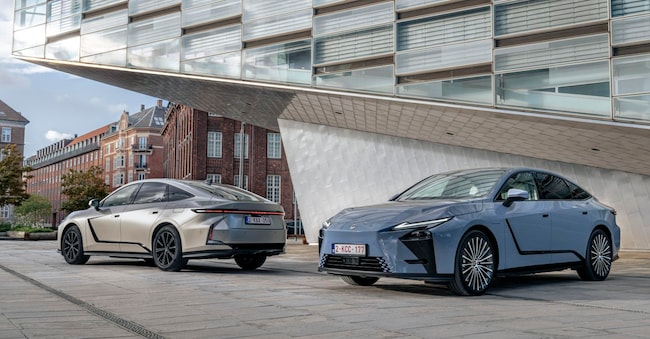
Key points
Five metres and fourteen centimetres in length, an interior designed with comfort in mind, and a range that looks firmly towards electrification. The new Lexus ES takes a new direction with its eighth generation, but does so without losing sight of the characteristics that have defined the model throughout its history.
We went to Copenhagen to test it on the road, spending most of our time behind the wheel of the ES 300h Full Hybrid – the powertrain that has been fitted to the model in Italia since 2018, when the seventh generation was launched.
Today, the range is expanding with the arrival of the 350e and 500e electric versions, with a claimed range of over 580 kilometres in the WLTP cycle. Orders for the Italian market are already open and the first cars will arrive from mid-October, with list prices starting at €62,700 for the 300h and €67,600 for the electric versions, excluding launch offers.
The dimensions of a large saloon
The new ES is built on the GA-K platform and retains its substantial dimensions, with a length of 5,140 mm, a width of 1,920 mm and a height of 1,560 mm. The wheelbase measures 2,950 mm, 80 mm longer than the previous generation, which significantly enhances interior space. The boot also offers a generous capacity, with 517 litres for the Bev version and 493 litres for the Full Hybrid. The platform has also been developed to accommodate different powertrain options and, in addition to the engines available at launch, Lexus has not ruled out the possibility of a plug-in hybrid variant being introduced in the future.
A sleeker design
In terms of design, Lexus draws inspiration from the LF-ZC concept unveiled at the 2023 Japan Mobility Show, from which the new ES borrows several elements that are set to define the brand’s new stylistic direction. The front end features an evolution of the traditional hourglass-shaped grille, which extends along the bonnet and towards the edges of the bumper, whilst the lowered bonnet helps to improve forward visibility from the driver’s seat.

