
Lexus RZ, the test of the electric suv that is driven with a cloche and manual gearbox
The Japanese brand is relaunching the battery-powered suv-coupé, updating it in terms of technology and offering it no longer as a single-version but with a full range.
3' min read
Key points
3' min read
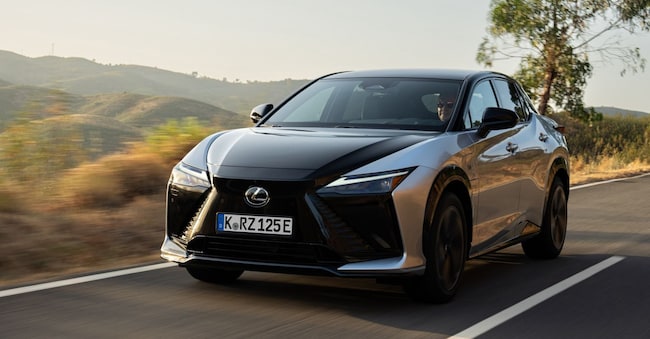
After three years, moreover spent in the twilight, Lexus' first electric native model gets a new lease of life. The RZ suv thus arrives at its second series under the effects of a very slight aesthetic update, but adopting new technologies and starting a family. In fact, from early next year it will no longer be offered in a single version but in three variants united by new technologies designed to optimise efficiency, dynamism and driveability, but also very different from each other.
Lexus RZ, what the three versions of the second series look like
The range of the new generation RZ consists of the front-wheel-drive 350e Executive single-engine version with 224 horsepower and a range of 570 kilometres, the twin-engine 500e Awd Luxury with 381 horsepower that can travel up to 500 kilometres before hooking up to the mains, and the all-wheel-drive 550e F-Sport twin-engine version with 408 horsepower that promises a range of up to 450 kilometres. The latter stands out both aesthetically and because as standard it offers a virtual manual gearbox with eight gears and steer-by-wire, i.e. a steering system with no mechanical connection between the steering wheel and the wheels to which it transmits commands via electrical signals and which puts a Formula 1-style steering wheel in front of the driver, which will also be available as an option for the intermediate version. In fact, the 550e is the RZ in which the greatest number of new features are concentrated, since those mentioned are added to those also present on the other two. In fact, it is also powered by a new 77 kWh battery, equipped with a 22 kW on-board charger and pre-conditioning, which using DC power up to 150 kW allows 10 to 80 per cent recovery in half an hour. In addition, more than its sister cars, it adopts a series of structural stiffeners, boasts a set-up calibrated specifically to reconcile comfort with determined behaviour, and makes use of ad hoc settings of both the electronics that manages dynamism and the all-wheel drive to homogenise cornering.

