
Lgbtq+, a June of demonstrations against discrimination and for rights
Rainbow community pride month takes on different meanings depending on the latitudes and laws in place in different nations: ranging from countries where it is illegal to be gay to the achievements of egalitarian marriage in Thailand and Greece

4' min read
Key points
4' min read
A month dedicated to a global minority. An achievement, 55 years after the Stonewall Inn riots, from which the fight against discrimination of the LGBT+ community began. It all began in 1969 with the clashes on 28 June between the police, who had organised a raid on the Christopher Street bar in New York, and homosexual and trans protesters.
Pride 2024
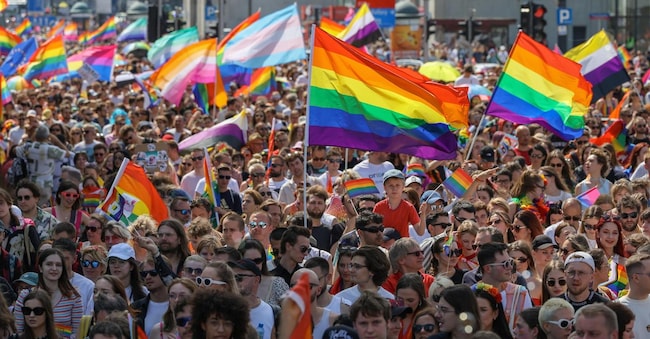
In 2024 Pride is a reality in several countries around the world. These range from the first Lgbtq+ parade in Kiev after the start of the Russian military attacks, which saw tense moments for the counter parade organised by neo-Nazis, to the demonstration in Lagos, Nigeria, as a challenge to repression; from the thousands of people in the streets for the annual Pride Parade in Jerusalem to the celebration of the two Native American spirits in the village of Miccosukee, Florida. Demonstrations that often transcend their original meaning to become an expression of freedom especially in countries where there is legal or de facto criminalisation against the LGBT+ community.
Community data
.A community that has gradually expanded its boundaries, as shown by the evolution of the acronym that has come to contain more nuances of sexual orientations: Lgbtqiap+ which stands for lesbian, gay, bisexual, transgender, queer, intersex, asexual, pansexual with the final + that opens up to all sexual orientations and non-heteroconforming gender identities. But which at the same time has aggregated support beyond its own community.
In Italy, for example, according to a report by Pew Resaerch, 73% of Italians interviewed declared themselves in favour of gay marriage, in a panorama where European percentages are much higher: 92% in Sweden, 89% in the Netherlands, 87% in Spain, 82% in France and 80% in Germany. According to the Ipsos survey published for Pride Month 2023, conducted in 30 countries around the world and involving more than 22,500 people between the ages of 16 and 74, 9% of Italians declare themselves to be Lgbtq+. In particular, 2% define themselves as homosexual, 3% as bisexual, 1% as pansexual/homosexual and 1% as asexual. Then there is a 4% who define themselves as transgender/genderfluid/non-binary.
The Italian figure is in line with the average of the 30 countries, but this percentage varies considerably between generations: figures range from 18% among GenZ to 4% among Babyboomers. Geographically, Spain, Brazil and the Netherlands have the highest number of people who identify as homosexual, bisexual, pansexual/homosexual or asexual. In contrast, Poland, Japan and Peru are the countries with the lowest percentages.


