Books

Life in London as seen from an Italian bookshop

by Nicol Degli Innocenti

4' min read

Translated by AI
Versione italiana

4' min read

Translated by AI
Versione italiana

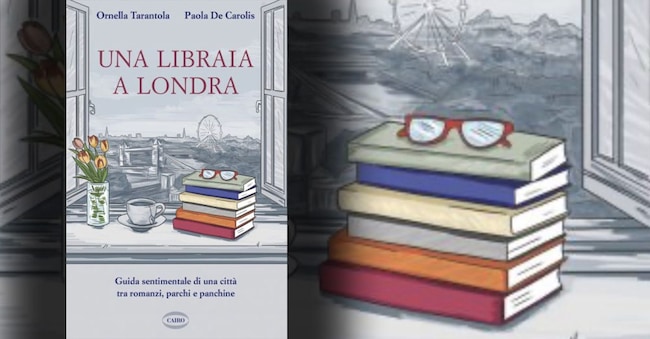
Two great, enduring loves have inspired this book, co-authored by Ornella Tarantola and Paola De Carolis: their attachment to London, their adopted home, and a lifelong passion for reading. The book also arose from the deep sorrow felt at the closure of the Italian Bookshop, the Italian bookshop in the British capital which, for thirty years, was not only Ornella’s job but her life and mission, and a cherished hub for the many Italians living in London.

“The closure of the Italian Bookshop was a blow to all of us who loved it and who, amongst its shelves, came to know Italian literature and its leading figures better,” explains De Carolis, a journalist at *Corriere della Sera* who co-wrote the book with Tarantola. “Everyone used to pop in to see Ornella. If a book can be an antidote, this very personal guide to a city that has meant so much to both of us is also a way of healing a wound.”

Loading...

Having spent most of her childhood in her grandparents’ bookshop in Brescia, Ornella had set off for London because she’d heard that an Italian bookshop was opening there. It had been love at first sight – both for the city and for that little shop on Cecil Court, a pedestrianised alleyway between Charing Cross Road and Saint Martin’s Lane, in the heart of the city.

The Italian Bookshop, run with love and great expertise by Ornella and a host of dedicated assistants, has for years been much more than just a shop: a symbol for the community, a welcoming oasis, a little piece of home, a refuge for homesick expats, and a small stage for emerging and established Italian writers.

It also helped to spread Italian literature throughout the English-speaking world: “There were those who came because they wanted to learn the language. There were those who wanted to read our writers in the original, no matter how much effort it took. There were those who wanted to understand Italia through our writers – perhaps the most honest way to understand a country. This was the Bookshop. To quote Guareschi, a small world, perhaps a bit shabby, certainly not the tidiest of places, but cheerful, with goldfish and fresh flowers.” Flowers always, because “flowers and books are life’s great joys.”

The book goes far beyond the Bookshop, offering a highly personal guide to the most enchanting places in and around London, always with a literary slant. From Charles Dickens’s home, ‘a house that is rich but not happy’, to the Freud Museum, ‘a place that conveys a sense of the sacred’, from John Keats’s home, ‘where one can refresh one’s soul’, to Monk’s House, where Virginia Woolf lived and died. When Ornella strolls through the streets of London, she follows in the footsteps of Mrs Dalloway.

The literary tour takes in streets and squares, parks and gardens, concert halls and jazz clubs, museums and markets. A visit to London’s favourite bookshops is a must, from Daunt Books in Marylebone to Waterstones Piccadilly with its thirteen kilometres of shelves, from Word on the Water in King’s Cross to Foyles on Charing Cross Road, which has a section dedicated to Italian literature. In the past, Miss Foyle, the founder’s daughter, had written to Hitler offering to buy ‘at a good price’ all the books he intended to burn. It seems the Führer replied with a polite refusal. Ornella’s message to readers is clear: “Always support independent bookshops, if you can.”

The Italian Bookshop, forced to leave Cecil Court due to soaring rents, had subsequently moved to Soho and finally to Gloucester Road before being forced to close due to the combined impact of the pandemic, online competition and, above all, Brexit, which caused so many Italians to flee London. “With Brexit, Covid and Mr Amazon, our midnight had come,” it reads. “In June 2023, on a very sad day of blinding sunshine, I closed the door for the last time and handed back the keys.”

Ornella had almost resigned herself to devoting herself to one of her favourite pastimes: ‘watching life go by’. Fate had other plans. The book has a happy ending: after the bookshop closed, Katia Pizzi, then director of the Italian Cultural Institute in London, offered Ornella ‘a lifeline’: a collaboration on a series of meetings between writers and readers. A host of figures accepted the invitation, including Benedetta Tobagi to discuss feminism, Grazia Verasani on thrillers, Daria Bignardi on prisons and loneliness, and Grazia Verasani on vampires and haunted nights.

“Long, lively chats have always been my forte,” says Ornella, and the meetings continue to be a great success under the current director, Francesco Bongarrà, “who has highlighted how Italian literature is translated into English, finally paying attention to brand-new works as well as the classics. The Institute isn’t some stuffy, institutional place: it’s dynamic, lively and interesting.”

Despite these wonderful initiatives, the closure of the Italian Bookshop remains a permanent void in the lives of the many Italians living in London and a wound that is still raw for Ornella. “I must admit that other people’s bookshops make me feel, on the one hand, infinite joy, and on the other, great sadness,” she writes. “They’ve made it; I haven’t. In my heart, I’ll always be a bookseller.”

Ornella Tarantola and Paola De Carolis, A Bookseller in London, Cairo, 223 pp., €17.50

Copyright reserved ©
Loading...

Brand connect

Loading...

Newsletter

Notizie e approfondimenti sugli avvenimenti politici, economici e finanziari.

Iscriviti