
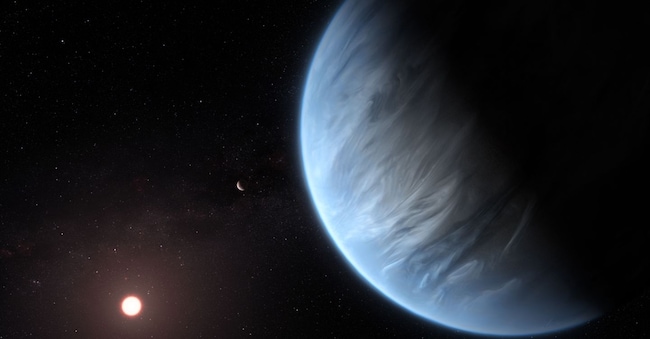
Traces of life on planet K2-18b, 124 light years away from Earth
Dimethyl sulphide and dimethyl disulphide, gases produced only by biological processes, identified on the planet

2' min read
2' min read
Scientists using the James Webb Space Telescope have obtained "the strongest signals of possible life beyond our solar system" by detecting chemical fingerprints of gases in the atmosphere of an alien planet that on Earth are only produced by biological processes. The two gases - dimethyl sulphide, or DMS, and dimethyl disulphide, or DMDS - involved in Webb's observations of the planet named K2-18b are generated on Earth by living organisms, mainly microbial ones such as marine phytoplankton, algae. K2-18b is a red dwarf star located about 124 light years from Earth, in the direction of the constellation Leo.
The planet could be full of microbial life, the researchers said. However, they emphasised that they are not announcing the discovery of actual living organisms, but rather a possible biosignal - an indicator of a biological process - and that the results should be viewed with caution, with the need for further observations.
However, they were enthusiastic. These are the first hints of an alien world that could be inhabited, said astrophysicist Nikku Madhusudhan of the University of Cambridge's Institute of Astronomy, lead author of the study published in Astrophysical Journal Letters. "This is a breakthrough moment in the search for life beyond the solar system, where we have shown that it is possible to detect biosignals in potentially habitable planets with current structures. We have entered the era of observational astrobiology," said Madhusudhan.
For some time K2-18b, a planet with a mass 8.6 times that of the Earth orbiting a cold dwarf, has been considered one of the most interesting candidates for the search for alien life because it is located in the so-called habitability belt, at a distance from its star such that it has an acceptable temperature, and because it has vast oceans of water.
Recent observations by the Webb Space Telescope, in particular those published in November 2023, had already attracted attention because they had identified the presence in the atmosphere of dimethyl sulphide, a molecule that on Earth is produced by ocean phytoplankton.

