
Inventory of light and colours: precious ideas made with ancient techniques
Unique pieces, watches and fine jewellery novelties emerge from a thick sea of Rocailles, rosettes, lampwork beads. Not simple bijoux, but artistic beads.
Concept by Nicoletta Ferrari. Photos by Laura Fantacuzzi and Maxime Galati Fourcade
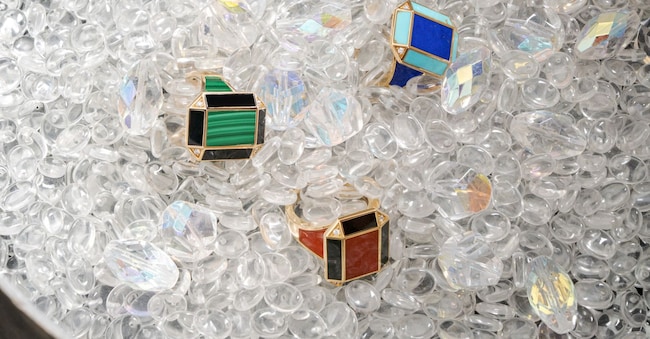
Beads, microbeads, Rocailles, rosettes, paper beads. The world of what are commonly called beads is specific and multifaceted, as fashion houses, jewellery designers or simple enthusiasts, who use them daily for their creations, well know. They have centuries-old traditions, as they were already used in the past to embellish clothes, trimmings, ornaments. The materials used have also always been among the most varied: they still range from glass paste to precious Murano glass. Here are the main types still on sale.
From Bohemia Rocailles (also known as conterie) are beads of different sizes and colours produced in Bohemia. They are obtained from tubes of glass or enamel paste cut into small cylinders, which are then heat-treated to assume their characteristic rounded shape. They are used for embroidery, trimmings, jewellery and ornaments, as well as valuable weaving work for dresses or small evening bags, or for floral compositions using fine wire. The shape and strength of Rocailles allow them to be used as the main material and to shape and structure even very complex jewellery composed of larger beads, such as faceted beads in half-crystal or Swarovski crystals, or for specific techniques such as Peyote and cabochon stone setting. Rocailles are the fundamental element in any handmade bijou.
FROM THE SERENISSIMA Micro pearls have a long and fascinating history. The very first creations using them can be traced back to Venice around 1300, and for a couple of centuries these pearls constituted a precious trade commodity for the Serenissima towards Africa, the Americas and India. After 1500, production migrated to today's Czech Republic, where it is still produced today in the area known as Crystal Valley, in the Liberec region north of Prague, and in the suburbs of the city of Jablonecnad Nisou, the mecca of glass jewellery and Christmas decorations. The first glass furnace was set up in the town of Mšeno in northern Bohemia in the early 16th century and is still in operation.
MURANO Many names, many techniques. Rosettes, invented in Murano in the 15th century by Marietta Barovier, Angelo's daughter, derive from pierced canes composed, like murrine, of several polychrome layers; lume beads, on the other hand, date back to the 17th century and are obtained from a solid, unpierced cane, heated by flame (hence the name lume) and cast on a metal wire held manually in constant rotation, with infinite variations of possible additions, effects and colours. More recent, paper beads are extremely light, each piece is entirely handmade using artisanal processes and a mixture of paper and cotton: the craftsman's skill allows for the creation of even substantial volumes and shapes, almost weightless.
A MILAN The special place where the pictures on these pages were taken, Maver, in Milan, has existed for 25 years. It has its own claim: perlinaro. No surnames for the owners, just Roberto and Leonardo, because this is where you get here solely by word of mouth, and is frequented by those who are looking for a bead (bead) for a personal passion or for couture embroidery and cannot find it anywhere else. There is a piece of history more than a century long, collecting a connoisseur's raw material - like the glass beads of the 1920s with gold leaf inside -, there are about 70 tonnes of merchandise and a lot of culture. The beads are bought by weight (from 10 to 80 euros per kilo): poor material for simple stories or great luxury.

