
Ligurian motorways, a plan to reduce summer traffic jams
The network. Director Fontana (Aspi): 'We are doing works that will give the modernised structures another 50 years of life. The most impactful construction sites will be able to create queues of 3-4 kilometres at most'.

4' min read
4' min read
Cit will still take another three to four years for the Ligurian motorways to completely emerge from 'a situation of impacting construction sites', which can be said to be essentially over 'between 2027 and 2028'. But, in the meantime, as early as 2024 there will be no 'heavy situations' for traffic and 'everything will improve still further'. This is explained by Luca Fontana, Autostrade per l'Italia's Director of Engineering & Construction, who takes stock of the works underway on the Liguria network, both in the summer and in the future. From now on, the impactful traffic restrictions, he explains, "will be able to create, at most, queues of 3-4 kilometres" on the network; no longer, therefore, interminable lines of cars, as happened in previous years (after the collapse of the Morandi viaduct - on 14 August 2018 - and with the start of the network maintenance process, which took place as a consequence), and "the trend will always be improving", reiterates Fontana, adding that the works "will give another 50 years of life to the modernised infrastructure".
Moreover, Autostrade's figures show that construction site days are also decreasing: "In 2020," he says, "they were 35,000; in 2021 about 20,000; in 2022 more or less 17,000; and in 2023 we are down to about 13,500 days. And with the year 2024, the structural modernisation work on the tunnels of the A26 will be almost complete, which will therefore have significantly less traffic impacted by construction sites. This will make it possible, from 2025 onwards, to move onto the other backbone linking Liguria with northern Italy, the A7, which until now has been little affected by construction sites. Then, by next year, we plan to complete the work on upgrading the fire-fighting systems in all the tunnels of the Ligurian network'.
At the moment, the company foresees investments on the Ligurian motorways 'amounting to EUR 2.27 billion, of which EUR 900 million has already been spent on modernising the network. These are estimates that will become more precise as we proceed'.
As far as the coming summer is concerned, Mr Fontana points out, as of 31 May the impacting construction sites (with permanent reductions to one lane and carriageway changes) have been removed, as provided for in the agreements made with the Region and the Ministry of Infrastructure. During the summer period, therefore, as in previous years, two lanes in each direction will be guaranteed on all the company's sections in Liguria. Only on the A26, in the Genoa Voltri-Masone-Ovada section, will there be some reductions to two lanes (out of the three available) to allow the continuation, even during the summer period, of some initiatives that are "a priority in terms of safety for users". From September, on the other hand, impacting roadworks will be reopened on the A26 Masone-Ovada, A12 Lavagna-Sestri Levante and A7 Ronco Scrivia-Isola del Cantone sections.
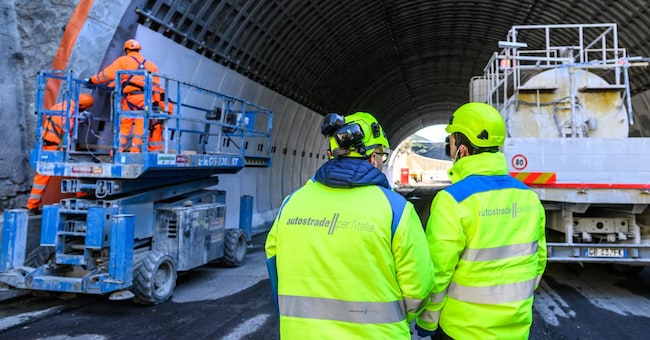
With regard, in general, to the works and investments planned on the Ligurian network, the worksites with the highest impact and expenditure concern the plan to modernise the tunnels, worth an estimated 1.17 billion. The project envisages the execution of a series of preliminary inspection surveys of the tunnels, which currently, Mr. Fontana clarifies, "is 60% advanced" and "the completion of the cognitive phase has been redetermined, in accordance with the new 2023 guidelines, dictated by the Mit, by 2029". In the meantime, however, progress is being made: "Today, structural upgrading work has been completed on 99 arches, equal to 42%" of the tunnels in the territory (which number 233, 39% of the national total managed by Aspi).


