
Lima: a whirlwind of flavours to discover Peru’s culture and history
From 2 to 4 November, the great capital will become a global stage for gastronomy with the 2026 edition of ‘The World’s 50 Best Restaurants’ ranking

Key points
When travelling through Peru, you can do so whilst sitting comfortably in a restaurant in Lima. As you savour a delicious blend of ingredients, one moment you’re in the Andes, the next in the Amazon rainforest, and the next on the beach at Máncora. Native potatoes (of which there are over 400 varieties), quinoa, kiwicha, maize, broad beans, oca and aromatic herbs – used for generations by Andean communities – are given new interpretations in contemporary cuisine. Likewise, camu camu, aguaje, cocona and paiche immerse us in ancient Amazonian traditions. And then there’s coffee, premium cocoa and, above all, the wide variety of fish and seafood, the basis of iconic dishes such as ceviche, pachamanca, juane, escabeche de pescado and lomo saltado. Peruvian cuisine has been making a name for itself for over 20 years. This is thanks to the ‘nouvelle vague’ launched by a group of chefs (led by Gastón Acurio Jaramillo) who, upon returning to the country after years spent abroad, sparked a major rediscovery of local produce, ingredients, and long-forgotten traditions, reclaiming them and launching a true manifesto of identity. In the name of this movement, young chefs have been trained who, through their creativity, have taken Peruvian cuisine to the world’s greatest stages. In 2011, the Organisation of American States declared Peruvian cuisine a Cultural Heritage of the Americas, and in 2025 the country was awarded the title of ‘Best Gastronomic Destination’ for the thirteenth time at the World Travel Awards. And Lima, a bustling metropolis with over 11.5 million inhabitants, is the epicentre of this culinary vitality, with its internationally renowned restaurants (Central and Maido, ranked number one in the world in 2023 and 2025 by *The World’s 50 Best Restaurants*), but also with the street food to be found in its markets (don’t miss the Mercado Central in the city centre and the more rustic Mercado Surquillo in Barranco), where you can savour criollo dishes. In just a few weeks’ time, from 2 to 4 November, the capital will become a global food and wine mecca for the 2026 edition of The World’s 50 Best Restaurants ranking.
The City of Kings
History has left an indelible mark on Lima. It was the most important centre in the New World, having already been home to pre-Hispanic cultures such as those of Lima and Ichma, and, during the Inca period, it served as the seat of the Viceroyalty of Peru, becoming the most influential political, religious, economic and cultural centre on the continent. Today, in the historic centre of the City of Kings (designated a UNESCO World Heritage Site in 1991), so named since Francisco Pizarro founded it in 1535, just a stone’s throw from Lima Cathedral, the ancient colonial houses surrounding the Plaza Mayor are the ultimate expression of Spanish splendour and power in South America. The architecture blends Baroque and Neoclassical elements with Moorish influences, featuring monumental covered balconies carved from wood, such as those of the Palacio de Torre Tagle or the Casa de Aliaga, built in 1535 on the site of an ancient pre-Hispanic temple, the oldest colonial residence in the Americas, inhabited continuously by the same family for 18 generations, or the Casa de Osambela, built in the 18th century with its distinctive watchtower from which the owner, the wealthy Basque merchant Martín de Osambela, armed with a telescope, would watch for the arrival of galleons laden with goods at the port of Callao.
In Barraco, amongst small galleries and ceviche bars
The ocean itself is Lima’s other great asset, stretching along more than 100 kilometres of coastline. The most beautiful views are in Barranco and Miraflores, districts where there is plenty to do and see. Barranco was the fashionable seaside resort of Lima’s middle classes in the early 20th century; today it is a bohemian neighbourhood frequented by artists and poets. Amidst carefully preserved 1930s architecture, a whirlwind of cafés, art galleries and ceviche restaurants, after a visit to the MAC, the Museum of Contemporary Art, you can stop off at some of the city’s most interesting restaurants. As well as the aforementioned, award-winning Central – the realm of the supremely creative Virgilio Martínez, who can even work his magic with piranha – there’s the tasty alternative of Siete (don’t miss the Boquerones de Pejerrey with avocado and aioli) or the more traditional menus at La Perlita and Isolina, where José del Castillo transports us to another era with his grandmother’s recipes. Just a short walk away is Dedalo, where local artists exhibit and sell their creations, ranging from clothes to jewellery, from handicrafts to luxury items.
From Miraflores to San Isidro
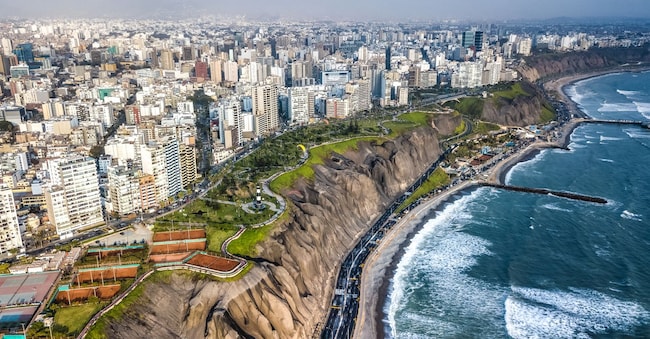
To the south lies Miraflores, the modern heart of the city, which overlooks the Pacific from the top of jagged cliffs and offers breathtaking views at all times of day. Known for its long beaches and its ‘Costa Verde’, it is a surfer’s paradise, offering dizzying waves. To reach some of the district’s main attractions on foot (Huaca Pucllana, the Museo de Sitio, Kennedy Park, Maria Reiche, Parque del Amor), a good starting point is the INNSiDE by Meliá, a lively hotel popular with young people in a truly strategic location, where, in the evening, you mustn’t miss the endless selection of tasty tapas at its Icataleya Rooftop Bar. Among the most interesting dining spots, alongside the aforementioned Maido – a place of excellence and the realm of chef Mitsuharu ‘Micha’ Tsumura, a pioneer and global ambassador of Nikkei cuisine (a fusion of Japanese tradition and Peruvian ingredients) – there is El Mercado, where you’re welcomed by Raphael Osterling, one of the most exuberant and highly regarded chefs of the moment, who also creates the dishes at the Rafael restaurant. The more traditional fare at Da Francesco is equally impressive.
In the heart of Miraflor, you can choose to stay at Atemporal, a Peruvian Tudor-style house dating from the 1940s, which has been restored and preserved in all its traditional character by the Andean Group. The house belonged to an Italian family, and its owner – now a centenarian – has always been committed to preserving it as a family home, maintaining its intimate, residential character rather than turning it into a conventional hotel. A 20-minute walk takes you to the elegant neighbourhood of San Isidro, home to Astrid&Gastón, the restaurant where, 20 years ago, Gastón Acurio and Astrid Gutsche began sharing their modern take on Peruvian cuisine with the world.


