
Lindt's strategy: premium chocolate against the rise of cocoa
With high-end products sold at higher prices, the company is better able to resist the commodity boom. The share has been weak on the stock exchange since the beginning of the year
class="dinomecognome_R21"> Vittorio Carlini
 Aggiungi Il Sole 24 Ore
ai preferiti su Google
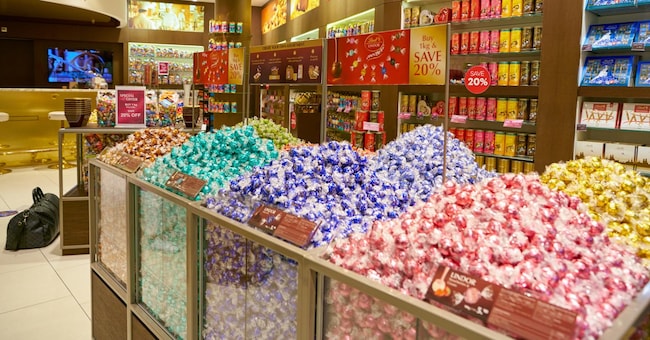
'Irresistible meltiness'. This is the well-known claim of one of Lindt & Sprungli's chocolates. Products whose production - evidently - has to reckon (also) with the price of raw materials. Above all: cocoa.
Commodity dynamics
Yes, cocoa. At the beginning of the year, the commodity was worth about $3,817 per tonne. Then, in April, it reached a first annual high in the $8,700 area. From there, the 'food of the gods' retraced to the $5,649 level. Today it dances around $9,180. These are numbers which, over the past 12 months, imply - as of 27/11/2024 - an increase of 119.6%. That is to say: a nice upward leap in prices, which - inevitably - affects Lindt & Sprungli's charges.
It is the same company that, in the presentation of the first half-year of 2024 (latest available data), points out that raw material costs - adjusted for inventories - rose to 31.6% of revenue. That is: a lower percentage than in the first half of 2020 (35.3%) and 2021 (33.1%), but higher than in the first half of 2022 (31.5%) and 2023 (30%). However, the impact of the accounting item on turnover is also 'moderate' due to the expansion of turnover. When looking at the absolute number, the trend described stands out even more strongly. On 30/6/2024 raw material costs - again adjusted for inventories - stood at CHF 683 million, compared to CHF 627 million in the same period a year earlier. In conclusion: the 'chocolate factory' has to deal with the high cost of raw materials. In particular, of cocoa.
The Challenge
That being said, the saver asks the question: how, and whether, the company is able to handle the situation? With reference to the first half of the year, it should be noted that turnover and - above all - profitability rose. Organic sales increased by 7% (+3.5% in Swiss francs). Operating profit, for its part, settled at CHF 292 million (+14.7% compared to the same period last year). Not only that. The Ebit margin - the ratio of operating profit to turnover - was 13.5%. That is to say: a percentage that is the highest of all the first half-years since 2020. Thus, the group was able to cope with the increase in raw material prices.
How? Apart from a one-off accounting event - related to the successful settlement of a lawsuit in the US - Lindt & Sprungli on the one hand exploited the pass-through lever; and on the other hand focused on operational efficiency. With regard to the first front, the company points out that - of the 7% increase in sales - 6.1% can be attributed to the trend in product prices (pass-through). With reference, on the other hand, to the second topic Lindt & Sprungli - among other things - emphasises how operating expenses have fallen to 27.4% of revenues (they were 28.5% a year earlier). Personnel costs themselves increased to CHF 520 million. But the company, again as a percentage of turnover, is keen to point out that the rise - compared to the first half of 2023 - is very moderate. In short: the message is that, in the face of the company's growth, the pressure on efficiencies and synergies of scale (as well as of purpose) is paying off.


