
Memory is the common thread linking the clues from the first test
An analysis of the exam papers set by the Ministry and of the differences between the authors and the topics proposed
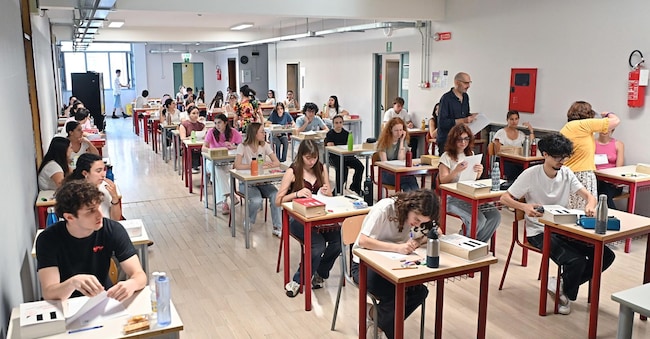
“It will be a clear sky”, like the sky on Thursday 18 June, is the one Cesare Pavese evokes when thinking of Constance Dowling in *Passerò per piazza di Spagna*, the poem chosen for category A1 of the school-leaving exam. Constance is already far away and the poet’s heart is already broken, yet her memory illuminates everything: “the staircases / the terraces, the swallows / will sing in the sun”; even “the stones will sing”. Memory is a common thread linking various sections of this school-leaving exam, and it is with this in mind that I await the results of the first paper. The memory of when one was happy: so wrote Pavese, and so wrote Vitaliano Brancati. ‘If we did not remember, the world would be very thin indeed,’ writes Brancati in a passage from *I piaceri*, and continues: ‘One of the most wretched conditions of unhappy times is not to regret happiness in vain, but to have forgotten it entirely.’
A circle of generations
It is therefore, above all, on memory that we are called upon to reflect today; after all, whilst schools update the texts we are asked to reflect upon, in the light of new insights, the ritual remains the same: dictionaries, register sheets to be certified one by one, gazes focused in the same way as ever, which similarly lift and strive, questioning the void, to grasp the exact word, then return to staring at the blank space between one line and the next. Without realising it, they bring to life the memory of those who came before them: including my own memory. I was just like them on the day it was my turn, and I was just like my father when it was his turn. It is a circle of generations coming together here, holding on to one another, blurring the boundaries; and, in that sense, I don’t think it’s a bad thing.
Furedi: the dangers of having no borders
By contrast, the sociologist Frank Furedi emphasises the danger of there being no boundaries between inner ages in an extract from his book, which bears the somewhat problematic title *Boundaries Matter*. Furedi speaks of ‘adultescents’, twenty- to thirty-five-year-olds who are unable to grow up, to take on responsibility, to mark and cross a boundary beyond which they can look back with the distance of memory, without idealisation or the fear of facing the monster—so disheartening to many—of being an adult, of being ‘mature’. A warning to the young people sitting here today: find the courage to evolve, and do not remain trapped in a daily superficiality which, year after year, could turn them into something that any good teacher would find sad for their pupils: nothing.
Metamorphosis and Struggle: Mario Calabresi
But transformation takes effort, and hard work is another major spectre of our times, as the journalist Mario Calabresi writes in *Alzarsi all’alba*. In far too many students, I notice a genuine aversion to any activity that requires even the slightest bit of effort, which is no longer (or no longer at all) regarded as ‘dedication, perseverance, patience and tenacity’, but rather an obstacle to be avoided in the name of bland comfort and the notion – which all too easily turns into a supposed right – of achieving a goal without breaking a sweat.
Saragat and the Constituent Assembly
Here, too, memory can help – if it is a form of civic remembrance, a heritage to be shared and perpetuated: the extract from the inaugural address by Giuseppe Saragat, President of the Constituent Assembly, on 26 June 1946. The Italian Republic’s “arduous path, fraught with obstacles” – so gruelling “yet rising towards the heights of freedom” – stands as a monument to collective commitment; it is a “march forward” for which we should be grateful every day – provided we do not let it slip our minds.

Brand connect


Newsletter Scuola+
La newsletter premium dedicata al mondo della scuola con approfondimenti normativi, analisi e guide operative
Abbonati