
Goal Programme, Lombardy exceeds targets six months early
Action launched under the NRP. More than 290,000 people have started a pathway, more than 150,000 have found employment and waiting times for the first service have been reduced to less than ten days

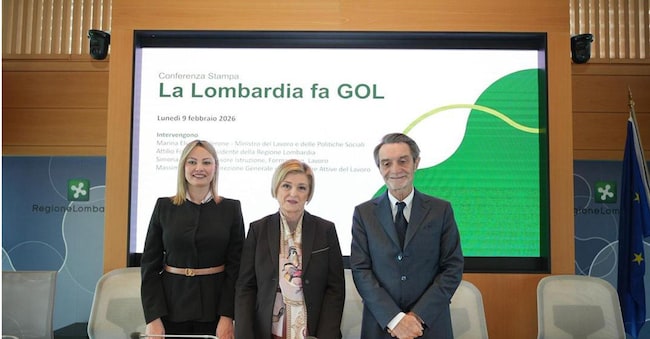
(Il Sole 24 Ore Radiocor) - The Lombardy Region has reached and surpassed the pre-established target of the objectives of the national Occupational Guarantee for Workers (Gol) measure six months ahead of schedule. The programme, launched as part of the Pnrr (it will therefore expire at the same time as the Pnrr) and designed to improve active labour policies and training, offers personalised and free of charge paths for labour insertion or reintegration, including vocational training (upskilling/reskilling). Aimed at the unemployed, social security recipients, young Neet and women, it provides an initial analysis to define the most suitable pathway. Looking at the numbers, more than 290,000 people have started a Gol pathway, more than 150,000 have found employment and the waiting time for the first service has been reduced to less than ten days. The distribution by year shows a steady growth trend, with 14,870 people treated in 2022, 65,502 in 2023, 92,584 in 2024 and 116,611 in 2025.
"The results gratify us, the steady growth in the number of men and women workers who have been able to get back to work is a source of pride for us. It has been an experiment and a positive experience that we hope will continue, in a context in whichthe employment situation in Lombardy is improving," said the president of the Lombardy Region, Attilio Fontana, during the presentation of the programme's results, emphasising that "the data show that these are not subjective evaluations, but absolutely objective, and that the Lombardy model works in all areas in which it is put to the test.
Calderone: decisive step change, let's accelerate on digital skills
Over the past three years, the Ministry of Labour and Social Policies "has led a decisive step change in the implementation of the Gol programme, transforming it into an integrated tool with the needs expressed by the world of work and accelerating the training of digital skills, on which Italia was far below the European average," said Marina Elvira Calderone, Minister of Labour and Social Policies, emphasising that "when State and Regions work togetherthe country grows more cohesive, inclusive and competitive. Today we are recounting a positive example of complementarity between the State and the Regions in managing a success story, the outcome of which was neither certain nor a foregone conclusion at the outset'.
"When we inherited the Gol programme, we were practically at the starting gate, to use a sporting expression, with a performance of 2% on the largest active policy programme in Europe and this was a problem. Today we can say that we did our job well and that the numbers are positive,' the minister said, emphasising that 'the results demonstrate the dynamism and high performance of the Lombardy labour market, with a great effort on the part of the Region's structures, but also with an important focus on the quality of the interlocution between the central level, i.e. the Ministry of Labour and Social Policies, and the regions, in this case the Lombardy Region'. Calderone added that 'it is important for us to support the Lombardy Region in strengthening the higher vocational and technical training channel', also because 'our task is to support good practices and to support the regions in a path of closeness to citizens, because an efficient public administration, which gives efficient answers to concrete needs, is what citizens are asking for'.
Fontana: Lombardy virtuous in labour policy attraction
Lombardy 'confirms itself as a virtuous model in the implementation of labour and training policies. The results of excellence achieved on a national scale are there for all to see," added President Attilio Fontana, pointing out that "the data indicate a significant increase in female participation, testify to the effort to digitalise processes for a better timeliness of responses, and demonstrate once again how collaboration between the public and private sectors has been the prerequisite for guaranteeing timely responses to citizens by offering an effective personalisation of retraining paths. Mr Fontana also emphasised that 'the structuring of Employment Centres as the first filter and access point for those who are unemployed, unemployable, or have lost their jobs in Lombardy has had as a further step the decisive contribution of the network of accredited operators as a specialist support and for targeted training'.


