
Hydroelectric, Lombardy receives 205 million in arrears in fees and free energy
The Court of Cassation ruled in favour of the Region: the appeals of the concessionaires who had failed to make the required payments were rejected and now they will have to pay

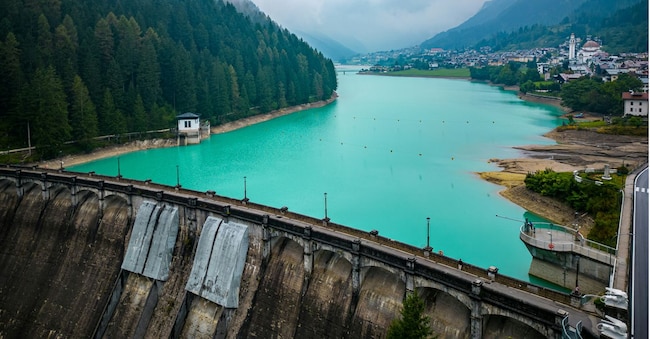
An allocation of almost 205 million euro is coming for the territories of the Milan Metropolitan City and the provinces of Bergamo, Brescia, Lecco, Sondrio and Varese from hydroelectric fees. This was confirmed by the Lombardy Region's Councillor for Local Authorities, Mountains, Energy Resources and Use of Water Resources, Massimo Sertori, after the Court of Cassation rejected the concessionaires' appeals, reaffirming that the fixed, variable and free energy fees are due to the Region and the territories by law.
The Supreme Court rulings
In the last few days, the judgments of the Supreme Court of Cassation, United Sections No. 2995-2026 and No. 3821-2026, have been published, which have intervened on the legitimacy of the 'binomial' fee for large hydroelectric derivations (a fee divided into a fixed component and a variable component) and on the free transfer of energy to the regions, against some hydroelectric concessionaires who had failed to pay the required amounts and had appealed against the measures adopted by the Lombardy Region.
The rulings confirm that the provisions introducing the binomial fee and the obligation to transfer energy free of charge apply to all concessions for large hydroelectric derivations, irrespective of their status (whether already expired, pending or to be granted in the future).
Payments and free delivery
"After years of legal battles," says Sertori, "the rulings of the United Sections of the Court of Cassation have definitively proved the Lombardy Region right, so the hydroelectric operators will soon have to pay the accumulated and unpaid sums, and the allocation of resources to the territories will be regularised.
The Lombardy Region, in implementation of national legislation, had already regulated the free supply of electricity. It should be noted that the regional law provides for the transfer of most of the fees to the territories on which the hydroelectric power plants are located, just as the free energy is mainly destined for the territories concerned.

