
Lombardy is the Italian queen of craft breweries
The region is home to 10 per cent of all brewing companies and is working on the creation of a made-in-Italy hop supply chain

3' min read
3' min read
Lombardy is the queen of craft breweries. The Unionbirrai figures speak for themselves: with 140 companies out of a national total of around 1,200, this is the Italian region with the most hop entrepreneurs, producing around 600,000 hectolitres of beer in 2022. Milan is home to one of the industry's pioneers, Birrificio Lambrate, founded in 1996 by Professor Giampaolo Sangiorgi. The same year, in the Como area, Birrificio Italiano was founded.
Like all the other craft breweries in Lombardy, they have in common their size: according to European legislation, breweries producing less than 200,000 hectolitres of unpasteurised beer per year are considered 'craft', 'but in our country even the largest breweries reach decidedly smaller numbers,' explains Simone Monetti, secretary general of Unionbirrai, the association that brings them together at national level. He also dispels a myth about the average age of the owners: 'It is not true that they are only young,' he says, 'or at least not any more. Many of them were young in the 1990s, when they started their first businesses'.
Today, craft breweries are a more mature phenomenon, and compared to past years there has also been a slowdown in new openings: 'In 2022, after the closure of Covid, we had a record year for consumption,' says Monetti, 'from 20l5 to 2019 there was a peak in growth. This year, on the other hand, for the first time we could be faced with a negative balance between new openings and closures'.
For craft breweries, the main distribution channel is pubs and restaurants, preferably in the vicinity of the production plants: 'Craft beers,' explains Monetti, 'have great difficulty entering large-scale distribution, both because the quantities produced are not sufficient and because, being unpasteurised beverages, they need the cold chain to be transported and stored. Typically, however, supermarkets store beer bottles on the shelves at room temperature'. There are a few breweries that distribute on a national scale, however: 'Only the biggest ones manage it,' says Monetti, 'and the biggest are almost all in Lombardy.

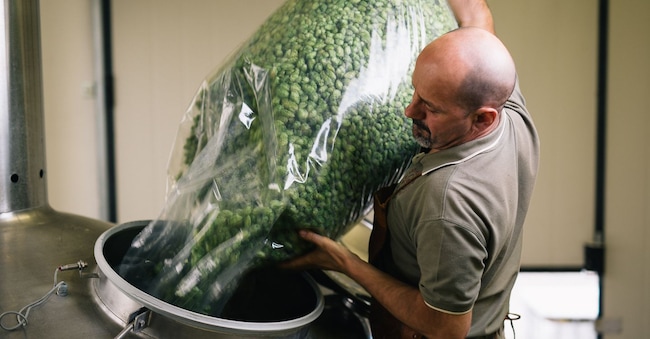
While it is not complicated to set up a plant for craft beer production, it is more difficult to create a local - or even national - supply chain for the raw materials, which are hops and barley. "That of building a product made with local raw materials is a project that many breweries are aiming at because it is considered rewarding from the point of view of image," says Monetti. "Today, about 10% of our members in Unionbirrai are agricultural breweries, i.e., farms that cultivate the raw material and then also make beer, closing the production cycle. Barley and hops made in Italy, however, are not available all year round for seasonal reasons. Moreover, to make beer, it is not enough to take the raw material off the plant: hops and barley must first be processed, and in Italy the missing piece is precisely that of processing.


