
Pedemontana Lombarda picks up the pace: work is progressing on the new strategic transport corridor
In an interview, the managing director, Sabato Fusco, takes stock of the projects currently underway, which represent a true model of urban regeneration. These projects focus on the well-being of residents and respect for the environment and the landscape

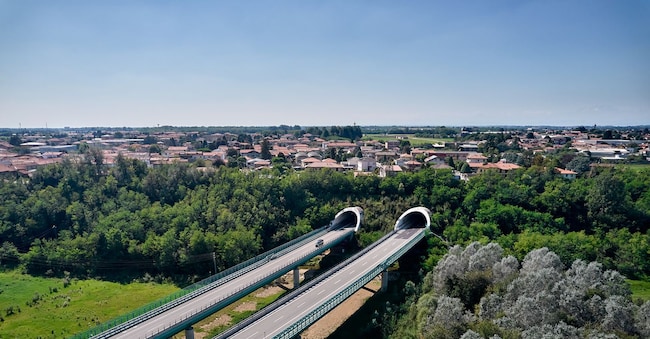
(Il Sole 24 Ore Radiocor) – Work is continuing at full speed on the Pedemontana Lombarda motorway, a strategic project for enhancing regional transport and improving links between the region’s main economic hubs. As explained by the managing director, Sabato Fusco, the work currently underway concerns section B2, involving the upgrading of the SP35 Milan–Meda road between Lentate sul Seveso and Cesano Maderno, and Section C, which will provide a temporary link – pending the completion of the final section of the A36 motorway to Agrate – Cesano Maderno to Milan’s Eastern Ring Road (A51) near Vimercate, establishing a new strategic axis for transport in Lombardy. These are complemented by a comprehensive system of related works and improvements to the local road network, which are essential to ensure the continuity of travel throughout all phases of the construction works. “Work is also at an advanced stage on the remediation of the areas affected by the 1976 Icmesa accident.” This is “a project that represents a crucial phase not only for the continuation of the infrastructure, but also for the environmental restoration of an area with a complex and significant history”, explains the manager.
“The route of the Pedemontana,” recalls Fusco, “runs through the plains and, although there are no restrictions, our motorway is 80 per cent underground . This decision was driven by a desire to minimise the environmental impact. This means that the motorway route is being built almost entirely in cuttings and tunnels, following the same model used for the construction of the Milan underground, or using traditional excavation methods, as in the case of Arcore. Diaphragm walls are therefore currently being constructed using machinery suited to the geological conditions of those sections of the route. We currently have four hydro-cutters in operation at our construction sites, and a further three are on their way specifically to speed up the work.”
The role of construction sites in the context of mobility
To understand the role these construction sites play within the broader context of transport, it is important to bear in mind that the works currently under way concern a section of motorway that ‘will be a genuine alternative to the A4 and A8 for travelling across Lombardy’, explains Fusco, who points out that the western section of the Autostrada Pedemontana Lombarda (A36) was opened and inaugurated in January 2015, including Section A (from Cassano Magnago to Lomazzo), the Varese Ring Road (A60) and the Como Ring Road (A59). ‘In fact,’ he continues, ‘the new motorway section will allow local traffic to cross Lombardy from east to west, bypassing the city of Milan. This will also serve to link the Monza Brianza area, a highly productive region: suffice it to say that the quadrilateral comprising Milan, Lodi and Pavia accounts for 13.6 per cent of national GDP. This project will significantly reduce journey times: from one hour to cover approximately 20 km to just over 10 minutes, assuming a speed of 120 km per hour’. This will, on the one hand, enable much smoother traffic flow but, above all, ‘improve the quality of life not only for the citizens who travel that stretch of road every day but, above all, for professional heavy goods vehicle drivers’. All this whilst keeping a close eye on respect for the environment and the landscape: “it will be a structure that blends in completely with the surrounding areas, without altering the landscape”.
Art as a path to regeneration
The projects on the Pedemontana Lombarda have been designed ‘in accordance with the latest environmental impact criteria. To give just one example, a large proportion of the Italian motorway networks, built between the 1970s and 1980s, discharged water directly into the environment. In our case, however, we have a collection system that channels the water directly into treatment facilities. Another aspect we have focused on is noise mitigation, achieved by constructing the infrastructure below ground level; and mitigation is also ensured at ground level through the use of noise barriers and sound-insulated tunnels. Finally, let us not forget the extensive planting of native species of trees and shrubs, which help to mitigate the visual impact of the motorway whilst at the same time improving life in the affected areas’. And it is precisely with regard to this focus on the local area that Fusco emphasises how ‘today there is a different mindset amongst those who design and build infrastructure projects. An awareness which, in some respects, has also been fostered by the different reception of infrastructure within the local area: it is realistic to say that today any infrastructure is accepted with a different degree of sensitivity compared to the past. Today we face a more important task than in previous years: we do not merely need functional and safe infrastructure; it must also possess a certain degree of acceptability on the part of those who live in those areas. Environmental considerations therefore become a further tool for integration, ensuring that local communities and populations share the need for an infrastructure project – in our case, a motorway. Those who design and build such a project must put themselves in the shoes of those living in the areas affected by the works. All this is, of course, linked to regulatory issues, with an environmental code that provides for direct mitigation funds as well as other forms of compensation for the affected area. In our case, we have not only complied with the regulations but have sought to go further. We have doubled the amount required by law and ensured that this sum was allocated in full to the local authorities through which the motorway passes, without including the motorway’s direct mitigation works in the environmental budget, thereby leaving more resources available to the local areas for projects they themselves have devised and which could further offset the presence of the motorway.”


