
Lomellina, in the field the rice that doesn't get sick. The first experiment
Research. At Mezzana Bigli, arborio plants are cultivated that have undergone genetic improvement techniques: the genome is modified without pieces of external DNA

4' min read
4' min read
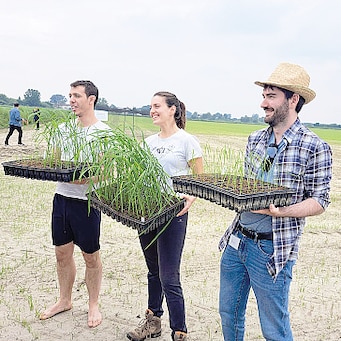
Veninety-eight square metres cultivated with arborio rice on the Radice Fossati farm in Mezzana Bigli, in the Province of Pavia. A handkerchief, to be precise, barely a third the size of a half volleyball court. Which, however, makes Lombardy the first Italian region to cultivate Tea, the techniques for genetic improvement with which the genome of a plant can be modified but without inserting pieces of external DNA, as in the case of the 'old' GMOs.
The experiment bears the signature of the Department of Agricultural and Environmental Sciences of the State University of Milan, with the support of the Lombardy Region. Rice is now a strategic product for the economy of the Lomellina region, and Pavia is the province with the largest percentage of rice fields in Italy, as well as the leading producer nationally and in Europe. Like all plants, rice is also subject to diseases - caused by bacteria or fungi - for which it is necessary to resort to agrochemicals and pesticides if one does not want to compromise significant portions of the harvest.
Among these diseases is Brusone, caused by the fungus Pyricularia oryzae, which can lead to production losses of up to 50% and against which there are few drugs available. Thus, in the laboratories of the Milan State University, as part of the RIS8imo project, a variety of arborio was created that has inactivated variants of three genes associated with susceptibility to Brusone.
The RIS8imo project began in 2017 and is the result of a long approval process by the Ministry of the Environment and Ispra. In many countries around the world - from the United States to China via Brazil - plants produced with Tea have long since been cleared through customs. In Italy, however, until last year these biotechnologies could not leave research laboratories. In fact, a 2018 European Court of Justice ruling equates Tea plants with GMOs and, as such, prohibits their spread. But while the European Union has still failed to update the legislation, something has changed in our country: an amendment to the Drought Decree of May 2023 made it possible to experiment with Tea plants in the open field. At this point, the Milanese university was able to apply to the Ministry of the Environment to transfer its experimental rice seedlings from the university's phytotrons to the rice field of the Radice Fossati farm.
"Rice is the most modified plant in the world," explains Vittoria Brambilla, Professor of General Botany in the Department of Agricultural and Environmental Sciences at the State University of Milan, who heads the RIS8imo project and personally supervised the planting of the seedlings at Mezzana Bigli. 'In Asia,' he continues, 'Tea-treated rice is already widely cultivated. Vines, wheat and tomatoes are also being studied today. We decided to start with rice to meet the production needs of our region. Brusone is a terrible disease, which devastates crops, and the pesticides needed to treat it are very expensive".


