
Loquis, a world of stories in podcasts
Geolocalised storytelling app expands beyond traditional tourism by focusing on corporate culture and different forms of travel
5' min read
5' min read
A geolocalised Wikipedia, full of information and stories that follow us by voice, or a Google Maps with audio guide that narrates in an original way places, even the most hidden ones, that escape the standardised tourist. With the ambition to evolve into a library of narrated memory, with the task of preserving voices and testimonies that will disappear tomorrow. This is Loquis, a travel podcast platform, which aims to grow to narrate not only the artistic, historical and scenic beauties of Italy, but to broaden the narrative - storytelling, according to the canons of contemporary marketing - of national culture, through the wine and food heritage and historical sporting venues, but also with the history of Italian companies.
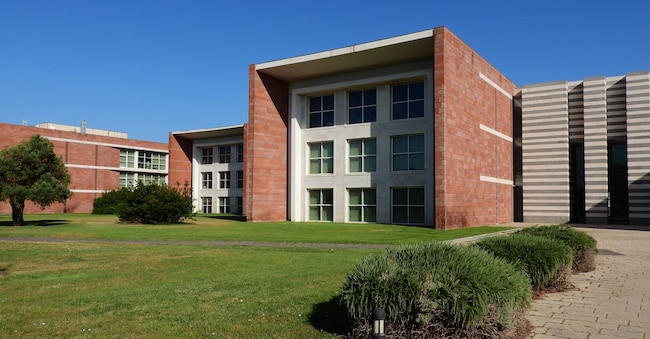
The Tiscali campus
.Just at the beginning of May, the route was launched to illustrate one of the most iconic places of the Italian digital economy, the campus wanted by Renato Soru as the headquarters of his Tiscali, the company that then opened up the telephony and internet market by throwing down the gauntlet to the public monopolist. Inspired by the Olivettian philosophy of the company as a community housed in a workplace that fosters collaboration and well-being, the Tiscali Campus, facing the Santa Giulia lagoon on the outskirts of Cagliari, aims from the outset to be a place where innovation meets landscape, technology dialogues with art and nature.
Business Cultures
.Set in a park of olive trees, where oil is still produced, the Arassociati studio's project, developed at the crossroads of contemporary minimalism and Sardinian building tradition, unfolds in a series of buildings in the warm colours of local raw materials, linked by Michelangelo Pistoletto's Hypertext portals, made up of words and concepts carved in stone that underpin the company's adventure, from communication to knowledge, from economics to art to politics. The campus is in fact also an open-air museum housing works by contemporary artists such as Pistoletto himself, Olafur Eliasson, Pinuccio Sciola and the Sardinian Costantino Nivola and Maria Lai, but there is also a nursery for employees' children in one of the first cases of corporate welfare. Today, the campus is still a technological hub that hosts around fifty companies, including Tiscali itself, and about a thousand people, confirming the still current vision of the importance of the place where one works.
The Tiscali Campus is just one example of the evolution of Loquis, created in 2018 as a podcast for travellers, based on an idea born on the road: Bruno Pellegrini, who already has several technological experiences in the media world behind him, was driving his car on the motorway wondering what the beauties in the vicinity might be. Today he can do so thanks to the non-invasive storytelling of his creature of which he is CEO, a platform that has now reached one and a half million users, 40 million unique users per year, 1.3 million contents in seven languages, of which over 100,000 are original. Today in this adventure Pellegrini has embarked on P101 and Cdp Venture as well as individual investors such as Carlo Feltrinelli and Bob Kunze Concewitz, former CEO of Campari.
Different cultures
.What he has created is a free atlas of stories, available to anyone, covering a bit of the world with a first layer of information obtained with artificial intelligence. To this has been added over the years original content related to individual places and emerging passions: Loquis aims to straddle all forms of tourism, broadening its target audience from the general tourist to those who love wineries and the richness of Italian food and wine, the stories of companies such as Ferrari, Olivetti or Tiscali itself, to those who travel along one of the many paths and cycle paths that cross the peninsula. Up to fans of monumental cemeteries or places linked to sports champions or even 'ghost tourism'.


