
Lorries, companies against overtaking ban on the A1
Aspi's decision: six months on the Incisa-Chiusi route. Transport operators: average time increase of 30 minutes and costs

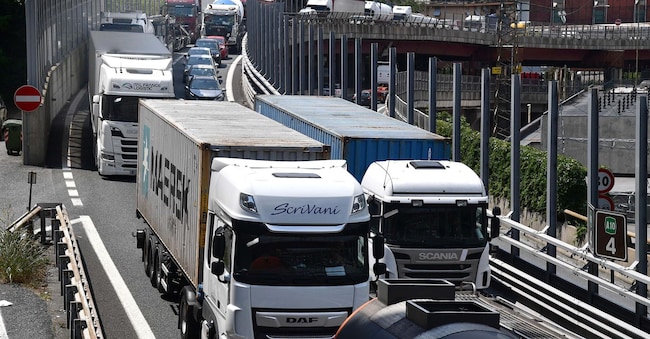
The decision by Autostrade per l'Italia (Aspi) to ban overtaking for trucks on the Tuscan section of the Autostrada del Sole (A1) motorway as of 3 November is fuelling controversy and discontent in the road haulage world. Category associations openly speak of 'a unilateral measure that penalises transport and logistics' and call for the urgent convening of a round table with the Ministry of Transport and Aspi to assess 'the actual usefulness of the measure and identify more balanced solutions'.
But let us proceed with order. The measure, which affects a stretch of about 90 kilometres in both directions between the Incisa-Reggello (Florence) and Chiusi (Siena) toll stations, concerns one of the busiest and most complex segments of the entire national motorway network. The vehicles affected by the ban are those with a total mass exceeding 12 tonnes. The stretch in question has two lanes in each direction, no tunnels but with a complex orographic conformation, and records a share of heavy traffic equal to about 30% of the total, higher than the national average.
The ban is experimental in nature and will last six months. At the end of the period, Autostrade per l'Italia, together with the Ministry of Transport, local authorities and prefectures, will assess the data collected to decide whether to make it permanent or possibly extend it to other similar stretches. The ban on overtaking carries penalties of up to EUR 666, suspension of the driving licence from one to three months and the deduction of ten points. The Traffic Police, in cooperation with the prefectures, will ensure controls along the stretch concerned.
But the road haulage industry does not agree. According to the companies, the measure was taken without any discussion with the associations representing the road haulage and logistics sector, which operate daily on that route and know its real criticalities. Says Alessandro Peron, genarle secretary of Fiap: "A unilateral decision of this magnitude, which directly affects journey times, operating costs and transport organisation, cannot be taken without a round table discussion with those representing the companies. According to initial estimates, the overtaking ban could lead to an increase in journey times of up to 30 minutes per route, with repercussions on fuel costs, drivers' shifts and the punctuality of deliveries, particularly for food and pharmaceutical transport and home distribution, where every minute counts.
Fiap recalls that the stretch represents a strategic axis for north-south connections and for the mobility of goods to and from the main production centres in Central Italia. Peron adds: 'Road safety is a priority shared by the entire sector, but it cannot be pursued with measures that only penalise industrial vehicles. If Autostrade per l'Italia and the competent institutions do not withdraw this measure and open a concrete and binding table, Fiap will not stand by and watch'.


