Louis Vuitton, a magnificent exercise in style to show yourself
Intimate elegance at Lanvin, carefree softness at Courrèges, beach swirl at Dries Van Noten, pastiche between masculine and feminine at Stella McCartney

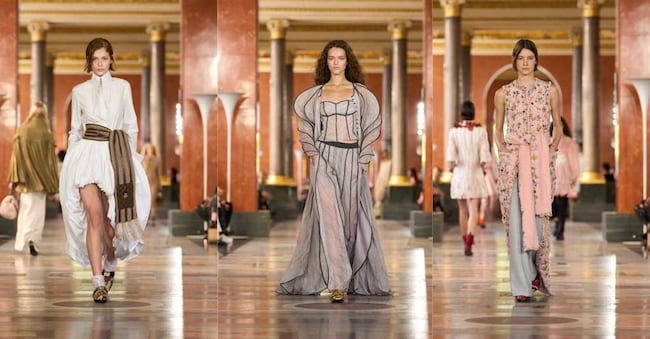
Locking in or escaping? The second day of the Paris fashion shows is dominated by opposing drives. To read in it a reaction to the horror of the present is all too obvious, but it is also necessary, in the knowledge, however, that refuge in the private sphere is also a form of escapism, perhaps the most reassuring.
"There is no place more embracing than one's own home," says Nicolas Ghesquière, who at Louis Vuitton explores the notion of dressing for oneself, that is, as much to be chez soi as to please no one, to have no audience. The show, by the way, is set in a recently restored area of the Louvre: the former summer flats of Anne of Austria, Queen of France, in which set designer and designer Marie-Anne Derville composes a contemporary mansion using furniture from different eras, from artist Robert Wilson's chairs to the creations of master cabinet-maker Georges Jacob, to Michel Dufet's Art Deco seating.
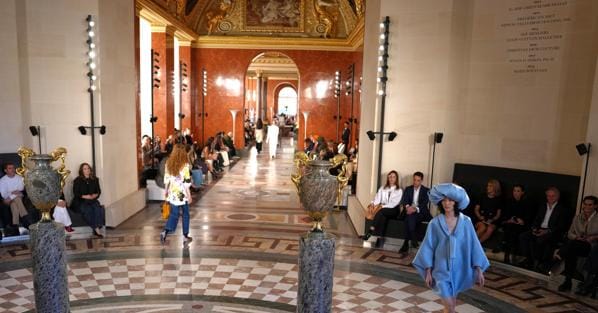
It is an immersion in French taste from the 18th century to the present day that welcomes a liquid vision of the Vuitton woman, always intimately traveller but no longer entangled in robotic rigidity, rather grappling with a wardrobe made up of petticoats, negligees, peignoirs, draped sheets and then slow pullovers, jacquard tapestries and more draperies, plus a few turbans that are not strictly necessary.
By languishing in the stylistic dictate, Ghesquière seems to warm up and move away from the abstractions that have characterised his recent work, but Vuitton's fashion remains marked by the formal flaw of being a magnificent exercise in style on the side of splendid accessories, a way of exploring an over-the-top dexterity that has little transcription into the real, when much could have.
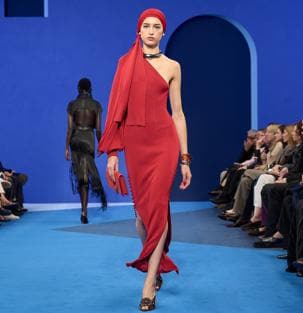
For Peter Coppings, at Lanvin, retiring home means rediscovering the 1920s, so representative of the maison's aesthetic. It is a potentially happy intuition, which lasts little on the catwalk, undermined on the one hand by a certain literalness, on the other by the tendency to accumulate, which fragments the discourse. Perhaps because it is free of archive references, the male section of the test - the show is co-ed - is more convincing. The expression, in any case, is elegant.