
Louise Bourgeois in Florence recounts the contradictions of motherhood
The works of the famous Parisian artist will be on display until 20 October at the Museo Novecento and the Museo degli Innocenti
3' min read
3' min read
It is an interesting combination to create an exhibition project entitled "Do Not Abandon Me" on one of the most singular and eclectic world artists of the 20th and 21st centuries - Louise Bourgeois (Paris, 1911 - New York, 2010) - and to place it in the Florentine context in close dialogue between the architecture of the Spedale delle Leopoldine, a place of education, shelter and rehabilitation for women, and the Museo degli Innocenti, founded in 1419 with the precise aim of welcoming children and infants without a home and family care.
Bourgeois's exhibition, curated by Sergio Risaliti and Philip Larratt-Smith, tells us a narrative about motherhood and the fear of abandonment in settings where similar emotions - fervid and conflicting - were actually experienced. This alone is enough to create an aura of poetry around the great event that will occupy Florence - cradle of the Renaissance - until 20 October 2024, transmuting it into something other than itself.
Museo Novecento
One hundred works by the French artist are presented at the Museo Novecento, including the famous 'Spider Couple' (2003). Bourgeois, who has made spiders her hallmark for communicating family and emotional ties between individuals, presents a pair of arachnids that could celebrate the mother/daughter relationship pursued by the artist since the 1990s ("My best friend was my mother"). The bronze work, located in the centre of the cloister, creates a sort of invisible 'spider's web' connecting the various rooms of the building: "All my work is evocative: it is not explicit. Explicit things are not interesting because they are too definitive and lack mystery'. Noteworthy are the gouaches on the ground floor, through which the artist in the last years of his life explicates his poetics of the uncanny with the "wet on wet" technique, a clear sign of relinquishing control over the final result, in which he dissolves and distorts the signs, making them metaphorical and no longer technical.
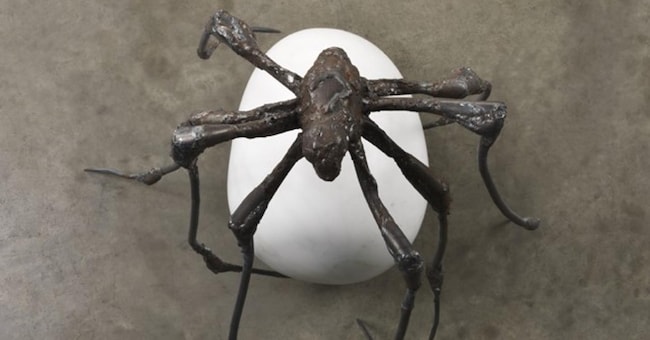
His vermilion flowers, created with the same compositional technique, exude a strong eroticism. Red, extremely significant for Bourgeois, evokes feelings of pain and passion, but also blood and emotion. Her gouaches, composed of pregnant women with extremely marked and hyper-feminised secondary sexual traits, have fetuses from which plants bloom, playing with the placenta or the umbilical cord. A theatre of the absurd that screams the relationship of odi et amo that is established between mother and daughter, linked to the artist's difficult family past: we thus witness in her creations a process of gestation, childbirth and X-ray nourishment. A Freudian reference to the dichotomous and complex concept of "womb-home": on the one hand the return to the womb to be reunited with the mother, on the other a perturbing feeling that recalls death. This concept is taken up in all the foreground works related to the fragility of human relationships, including the series "The Family" in red ink, where Bourgeois' entire family is metaphorically represented. Of great impact is the creation that gives the exhibition its title, born from the collaboration with the British artist Trace Emin, composed of sixteen digital fabric prints. Two sculptures close the exhibition: the first, entitled "Le Trani Episode", refers to sexual ambiguity with phallic and feminine forms and is reminiscent of Brancusi's scandalous and talked-about "Princesse X", also composed of an uncertain masculin féminin. "In real life I identify with the victim, in my art I am the murderer": the second sculpture, 'Spider', can be represented by this quote from the artist. Once again, a bronze spider towering over a marble egg refers to the dichotomous yearning between maternal protection and obsession with control, enveloping the egg/child in a suffocating spiral. "One cannot restrain the present. Every day you have to abandon your past. And accept it. [...] If you refuse to abandon it, then you must recreate it."
"Do Not Abandon Me", Museo Novecento (Florence), until 20 October 2024

