
Love and anger in the saddle
A docufilm reconstructs the life and mysterious death of Ottavio Bottecchia, the first Italian to win the Tour de France one hundred years ago, in 1924
5' min read
5' min read
Maria Luisa Colledani
For the French, Botescià is more than a cycling legend, for the Italians he is still not enough. Ottavio Bottecchia, the eighth of Francesco and Elena's eight children, was the first Italian to win the Tour de France, one hundred years ago, on 20 July 1924. And he remains the Italian cyclist with the most yellow jerseys (34), beating out two legends such as Gino Bartali (23) and Fausto Coppi (19). In short, Botescià is a hero from the pioneering years of the great stage races and is still not celebrated enough for his epicness.
The docufilm by Franco Bortuzzo
Now, he is the protagonist of Ottavio Bottecchia, el Furlan de fero, produced by RaiSport, written and directed by Franco Bortuzzo, RAI sports reporter. The docufilm is a precious album of cycling and history because the polyphony it creates makes Bottecchia's human and sporting story a shared history, a common heritage (the national premiere presentation is on 2 June, in Gemona del Friuli, at the Teatro Sociale, 8.30 p.m.; the broadcast on RaiSport is scheduled for 27 June). There are moving vintage images, of cyclists conquering the slopes of the Tourmalet or the Izoard by zig-zagging up to the top at 3 km/h, there are young faces of athletes marked by the wrinkles of fatigue, many historians (above all the expertise of Claudio Gregori and Beppe Conti), the voices of Bottecchia's heirs, silent collectors who saved the cyclist from oblivion and his colleagues today, above all Alessandro De Marchi.
Bottecchia, a borderline man, was born in 1894 in San Martino di Colle Umberto between Veneto and Friuli. Nobody knew him until 1923, when he came first among the underdogs (i.e. cyclists without a team who had to make do with everything) at the Giro d'Italia (and fifth in the general classification), and second at the Tour, the first Italian on the podium of the French race. And he could have won it, that 1923 Tour, were it not for the fact that during the stage to the Izoard, an envious little hand diluted a laxative in water bottle no. 29 (it was the first Tour with numbered water bottles), which cost him a 40-minute delay at the finish and the final victory. He was 29 years old, five of which had been spent in the war, and on the front line as a cyclist bersagliere with his 16-kilo bike and 20-kilo machine gun. During the retreat following the defeat at Caporetto he rode 170 kilometres with his war paraphernalia, hid in a canal and successfully crossed the Piave to join his family in Vittorio Veneto. This is Bottecchia, a man before a cyclist, and when he got on his bike, he gave quarter hours to his opponents.
Historic images and living witnesses
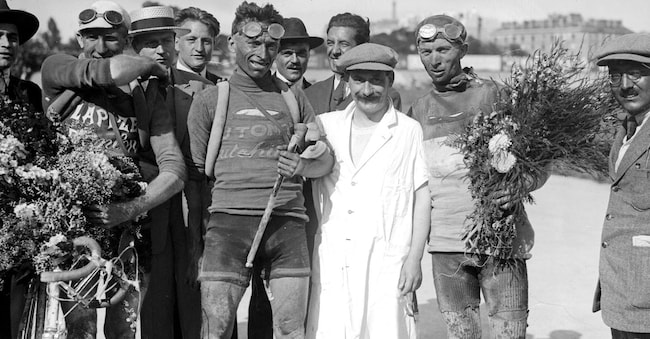
.The period pictures are wonderful: Bottecchia has a face sharpened by the fatigue of living, with 'that sad nose like a climb', his skin burnt by the weather, he wears a shirt and trousers with patches. When he presents himself to the director of Automoto, no one believes him, too badly off, with a cardboard suitcase in one hand and a handlebar in the other, but he does not lack the thirst for victory, for redemption: The Tour of 1924 was his, he wore the yellow jersey from the first to the last stage (before him Maurice Garin in 1903 and Philippe Thys in 1914, when the yellow jersey did not yet exist; after him only Nicolas Frantz in 1928 and Romain Maes in 1935), to the amazement of all, and with a team that was not exactly his friend... He also recounts this in a diary written in Venetian for the 'Guerin'. "Sto mato de Furlan' pedals out of rage and love, he has a half-full team but the fire beats inside him: 'I don't race for sport, nor for the cheers of the crowds, nor for the flowers of beautiful girls, and even less for glory. I run to earn money, as much as I can, and there will be no hardship or suffering enough to take this nail out of my head; to earn chips. I run for my family and I do not fear suffering. I have endured much more and certainly with less profit. I run for my family, they are poor and I will do everything I can so that they do not live in misery'. He learnt to read and write and through the Pélissier brothers he came closer to the socialist ideals of freedom. He also won the Grande Boucle in 1925, dominating on those offset roads and in those stages of 400 or more kilometres a day. For the French, he is a legend of the road and not of fascism: 'To have won two Tours like Coppi and Bartali but to have been in yellow more than the two champions testifies to Bottecchia's greatness,' explains Claudio Gregori, cycling historian and passionate two-wheel aide. 'In these numbers there is all his greatness, as an athlete with a winning mentality, a model also for today's Italian cyclists who 'disappear' as gregari in the big international teams'.


