
Luca de Meo (Renault): 'In the automotive industry it is agility and not size that counts now. And small cars are also needed

3' min read
3' min read
There are two spectres lurking in the Europe of the car: the Cafe regulations of 2025 and a crisis of sales (and ideas) that threatens to sink historical brands and large groups.
"So who will be the Nokia of the automotive industry, the too big to fail that, unable to adapt Darwinically, will succumb?
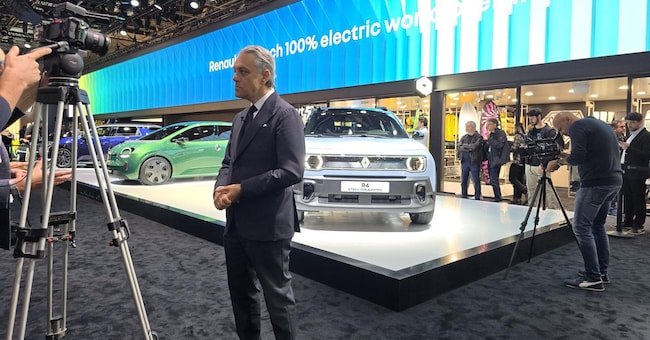
"To this question from Il Sole 24 Ore, Luca de Meo, CEO of the Renault group, answers in a round table on the sidelines of the Paris motor show, where the French manufacturer launched the electric R4, a 4.0 interpretation of the historic and iconic model.
"To win in the car business, says de Meo, it is no longer a question of economies of scale and size. Until a few years ago it was said that, to survive in the automotive industry, you had to be big, with dozens of brands and models to make synergies. Now the world has changed: what wins is agility, quick decision-making and the ability to draw competitive scenarios and adapt quickly. With the covid, the chip crisis, the war in Ukraine and the current car crisis the paradigm has changed, in my opinion, and the small ones, like Renault, which a few years ago risked annihilation, are now doing well, selling and making margins".
Renault, according to the ceo is well positioned and solid as opposed to the big European groups that risk in the current overlapping crisis (Luca de Meo does not mention them directly but obviously refers to Volkswagen Group and Stellantis, ed.)
After all, in recent weeks the European giants have been issuing worrying profit warnings
"At the moment," says de Meo, "there is no cause for concern and, barring any random and unpredictable events, we confirm the targets. Obviously, since we are dealing with cash, unforeseen events can happen, and in the automotive sector all it takes is a big strike by lorry drivers to create negative situations.
We have developed a cost structure that allows us to compete effectively on electric and thermal and, above all, to be fast. For example, we developed the Twingo (launched as a final concept yesterday together with the R4. ed) in less than two years. In the current context, speed is an advantage and that makes it easier for us'.
The most sensitive issue facing the automotive industry at the moment, in addition to the complex topic of more or less fair competition from Chinese manufacturers and tariffs, is the approaching operationalisation of the Cafe emission standards. From 2025 the limit will fall by 19% to 94 g/km: an unattainable threshold for almost everyone. Until now they would have been above the average threshold of 116 gr/km CO2, but by selling a share of electrics and plug-in hybrids almost everyone has avoided them (or bought credits from Tesla). The problem is only one: Bevs sell very little. And next year, manufacturers risk having to close plants or cut production.
"This is a gigantic problem," says de Meo, "that must be tackled as soon as possible because 2.8 million cars, which corresponds to dozens of factories, are at risk. And thousands of jobs are at risk because of regulations decided in 2016, with a different scenario and based on unreliable studies'.
The EU and member states must therefore, according to Renault's CEO, who is also president of Acea, act now, correcting the regulations, bringing them back to the reality of the market and technology because at stake are significant portions of that 10 to 12 per cent of European GDP generated by the automotive industry.
Finally, Luca de Meo relaunches a theme dear to him and inherent in the Draghi report: the constitution of the airbus of the car to cut costs and make a team in Europe especially on the small cars front where the Italian manager hopes for a change in regulations to create a market like the Japanese k-car market.


