Airlines

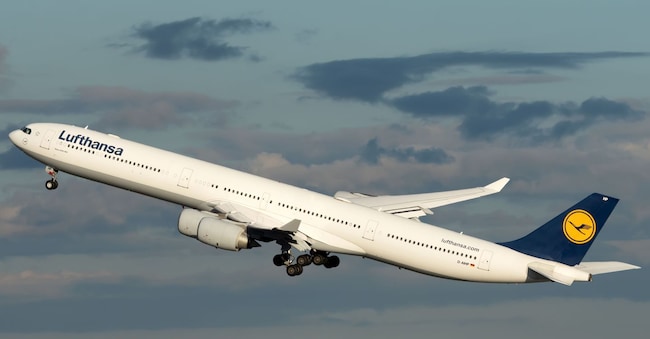
Lufthansa’s final flight for the Airbus A340-600: the era of four-engine aircraft comes to an end

The aircraft ended its service with a flight from Washington to Frankfurt. High fuel consumption and the rise of twin-engine aircraft are hastening the decline of large aeroplanes

4' min read

Translated by AI
Versione italiana

4' min read

Translated by AI
Versione italiana

Another icon of long-haul commercial aviation has bowed out. Lufthansa’s Airbus A340-600 made its final scheduled flight on flight LH419, landing in Frankfurt on Monday 19 October after an eight-hour and five-minute journey from Washington DC. On board were 275 passengers and 15 crew members. This brings to a close, after 23 years of service, a chapter in the history of the German airline and of intercontinental aviation. The retirement of the A340-600 is part of a wider transformation in air transport. Four-engine aircraft have gradually become less competitive due to high fuel consumption and operating costs, whilst new-generation twin-engine aircraft, such as the Airbus A330 and A350 and the Boeing 787, offer greater efficiency on long-haul routes.The four-engine Airbus, however, has not yet disappeared from the skies. Several airlines continue to operate the A340, particularly on intercontinental routes. Lufthansa will retain the smaller A340-300 in its fleet, whilst other operators, including Swiss, Edelweiss Air, Syrian Air and Iran Aseman Airlines, continue to use certain versions of the model. There are also charter and government operators. The number of aircraft still in service is now limited compared to the past, but the aircraft retains a role in specific market segments.

Loading...

From the era of four-engined aircraft to the twin-engined revolution

The A340 was developed for intercontinental flights at a time when four-engine aircraft were the established solution for long transoceanic routes. Its configuration enabled it to operate in accordance with the regulations in force at the time, before regulatory and technological developments led to the widespread adoption of twin-engine aircraft.

Loading...

The A340-600 variant, in particular, stood out for its imposing size. At 75.4 metres in length, it was considered the world’s longest passenger aircraft at the time of its launch, before being surpassed by the Boeing 747-8. Its capacity was around 440 passengers, depending on the interior configuration, whilst its stated range was approximately 13,900 kilometres.

The A340 programme came to an end in 2011, following the delivery of a total of 377 aircraft across the various versions. The first variants, the A340-200 and A340-300, entered service in the early 1990s. In the early 2000s, the A340-500 and A340-600 versions were introduced, featuring longer fuselages, greater fuel capacity and new-generation Rolls-Royce engines. For Airbus, this latest version was not a success, having sold only 67 aircraft.

The A340-500 was designed for ultra-long-haul routes. Singapore Airlines used it from 2004 on its direct Singapore–New York service, with flight times of up to around 18 and a half hours. Over the years, Lufthansa has operated various variants of the family, including the A340-200, A340-300 and A340-600.

The A380 and 747: giants of the past

The history of the A340 is intertwined with that of the other large four-engine aircraft in commercial aviation: the Airbus A380 and the Boeing 747. The former entered service in 2007, designed to offer very high capacity for connecting major international hubs. The latter, a mainstay of air transport for decades, ceased production in 2023.

The three models were designed to meet different requirements. The A340-600 was optimised for long-haul flights, featuring a single passenger deck and four engines under the wings. The A380, on the other hand, introduced a double-deck configuration extending practically the entire length of the fuselage, offering unprecedented interior space. The A380-800 version can carry around 450–550 passengers, although capacity varies depending on the configuration.

Although it is shorter than the A340-600, the A380 is much larger and can carry a significantly higher number of passengers. Its operational model is based primarily on high-demand routes between major international airports, such as Dubai, London Heathrow and Singapore.

Emirates is currently the world’s leading operator of the A380 and continues to deploy the aircraft on routes with high passenger volumes. The Boeing 747 also remains in service with a number of airlines, including Lufthansa and Air China, although its use is now largely concentrated on cargo transport.

The gradual phasing out of four-engine aircraft reflects a structural shift in the sector. Modern twin-engine aircraft, such as the Airbus A350 and Boeing 787, are capable of serving many of the routes that once required, or made it cost-effective to use, four-engine aircraft, whilst generally consuming less fuel per passenger carried.

Loading...

Lufthansa steps up its fleet renewal programme

The withdrawal of the A340-600 forms part of Lufthansa’s wider fleet modernisation programme. By 2027, the group also plans to phase out the A340-300s, the Airbus A330-200s and the Boeing 747-400s.

The replacement fleet will consist of new-generation aircraft, including the Airbus A350-1000 and the Boeing 777-9. According to the manufacturers’ estimates, the new aircraft will reduce fuel consumption and emissions compared with the aircraft they are replacing, as well as improving passenger comfort and reducing noise levels.

Meanwhile, the Boeing 787-9s have already joined the group’s fleet, and further deliveries are planned. The aim is to gradually increase the proportion of next-generation aircraft in long-haul operations, whilst reducing the number of different models to manage.

Fleet rationalisation, in fact, brings benefits that go beyond fuel savings. Greater standardisation of aircraft simplifies maintenance, operational planning and crew training, helping to reduce organisational complexity and costs.

Lufthansa is therefore aiming to ensure that, by 2028, around 70 per cent of its long-haul fleet will consist of new-generation aircraft. This strategy reflects the direction being taken by the entire sector: fewer four-engine aircraft, greater efficiency and a fleet increasingly geared towards economic and environmental sustainability.

Copyright reserved ©
Loading...

Brand connect

Loading...

Newsletter

Notizie e approfondimenti sugli avvenimenti politici, economici e finanziari.

Iscriviti