
Luiss inaugurates the 2024-2025 academic year
Guest of honour James Manyika of Google. The challenges of (Human) Artificial Intelligence at the centre of the ceremony. Birth of the 'AI4Society' Research Centre announced, which aims to become an international reference point for critical and transversal reflection on AI
3' min read
3' min read
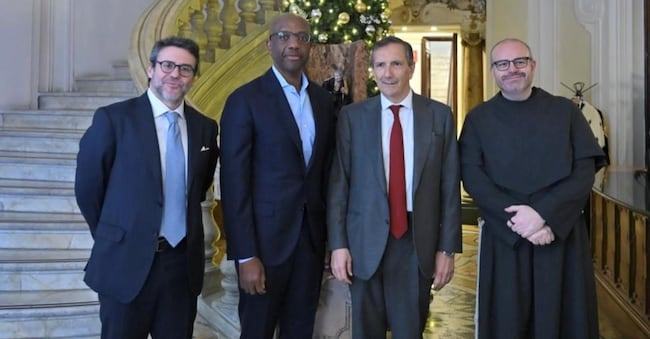
Luiss Guido Carli University celebrated today, Friday 13 December in the Aula Magna of the Viale Pola Campus, the inauguration of the 2024-2025 Academic Year, in the presence of its Top Management and the guest of honour, James Manyika, President Research, Technology & Society of Google. The theme of the Ceremony was the Artificial Intelligence revolution, analysed in terms of opportunities, educational challenges and ethical implications, during a dialogue between Manyika and Father Paolo Benanti, President of the AI Commission for Information at the Presidency of the Council of Ministers.
The University of Tomorrow
"Designing tomorrow's university also means taking into account the profound transformations introduced by Artificial Intelligence in higher education systems at a global level, enhancing its benefits for teaching and research," said Luiss Rector Paolo Boccardelli at the opening of the ceremony, continuing: "In order to truly govern AI, the world of higher education has the responsibility to build learning models that adapt machines to the skills and values of the individual, leveraging reflexive skills and the development of critical thinking, with a strong focus on skills. Universities, and in particular Luiss, promoted by Confindustria, are increasingly called upon to play an active role in society, preparing aware and committed leaders who know how to face and manage the digital revolution'.
Involvement of all
."We need the involvement of everyone in society: scientists, ethicists, policymakers, teachers and students, to name but a few, to develop AI properly," said James Manyika, president Research, Technology & Society at Google, adding: "Students and students will be essential to ensure that we maximise the benefits of AI for the benefit of everyone, everywhere, while addressing its complexities and risks." The need to reconcile technological innovation and social progress, with an ethical approach oriented towards the common good, was emphasised by Father Paolo Benanti, in his dialogue with Google's top manager, moderated by Professor Irene Finocchi, Rector's Advisor for the University's Digital Transformation..
The 'AI4Society' Research Centre is born
.In line with this commitment, Luiss also announced the creation of the "AI4Society" Research Centre, which aims to become an international reference point for critical and transversal reflection on Artificial Intelligence, analysing its impacts and implications through the dual lens of scientific disciplines and social sciences.
The new Centre was presented by Professor Giuseppe Italiano, who was appointed pro-rector for Artificial Intelligence and Digital Skills this summer: the University named after Guido Carli was one of the first in Italy to introduce this figure, with a supervisory role on innovative study paths that combine technology, sustainability and interdisciplinarity, such as Management and Artificial Intelligence, Global Law and Strategic Management. And more. The Libera Università Internazionale degli Studi Sociali recently introduced the Certificate of AI Literacy: a badge, compulsory from this year, to ascertain the digital skills of undergraduates and master's graduates, with the prospect of extending it to three-year courses as well.
Continuous change
.At the conclusion of the Ceremony, Luiss President Luigi Gubitosi commented: 'The future of skills will be marked by continuous change. The reflections of James Manyika and Father Paolo Benanti on the future of generative AI, new digital rights and the need for sustainable innovation are consistent with the values of our University. We are certain that their testimonies and their example as pioneers in the development and regulation of Artificial Intelligence will be an inspiration to our students. The complexity that characterises a future that is already present,' concluded Gubitosi, 'requires a new generation of global and responsible leaders, capable of facing the current challenges. This is the mission of our University'.
Brand connect


Newsletter Scuola+
La newsletter premium dedicata al mondo della scuola con approfondimenti normativi, analisi e guide operative
Abbonati