
Prencipe: 'Luiss increasingly international, innovative and interdisciplinary'
The rector takes stock of his six years at the helm of the university: one thousand international students, lecturers of 40 nationalities, 69 double and triple degrees, Ia in all degree courses
10' min read
10' min read
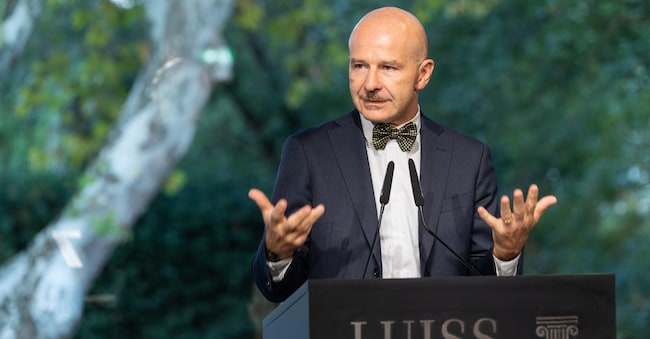
These are the last days at the helm of Luiss for Andrea Prencipe. After a double three-year mandate that has seen epochal changes in the academic world and beyond. From Covid, which has overturned teaching times and spaces, to the two wars still underway, one of which (the one in the Middle East) has awakened student protests, and the disruptive advent of artificial intelligence. Arriving almost at the end of his "3D rectorate, the rectorate of the three diversities: internationalisation, interdisciplinarity and innovation", Prencipe looks back and casts his mind back to 2018 when, accompanied by Alessandro Zattoni, head of the Luiss Department of Management, he was visiting King's College in London with the intention of launching a double degree, encountering scepticism from a reality that was among the top 20 in the world. Six years later, there are five double degree programmes between Luiss and King's college, 69 in total, plus two triple degrees and a couple more on the way. 'Two months ago,' Prencipe recounts, 'the rector of King's college was with us, he chose us for his first visit to Europe. Looking back is also a way of taking stock of his adventure in the saddle at the Free University of Social Studies founded by Guido carli in 1977 and hoping for 'continuity' from those who will come after him. In the knowledge, he emphasises, that 'universities are places where one not only learns but where one learns to learn and unlearn'.
We start here rector. What does that mean?
Loading...
Universities have always been places where one learns through debate, through lectures, the peripatetic school and various ways of sharing knowledge. In the 1990s, the European Union began to emphasise that the university should also be a place of learning. It is a context in which one acquires metacompetences that enable one to learn not only what is shared with him or her during university but also in the work context. And even at that time, the concept of life-long learning and continuous training began to be strongly proposed. At Luiss we also emphasise the importance of learning to unlearn because the challenges or crises that characterised the years of my rectorate, starting from Covid to the wars on artificial intelligence, are crises or challenges characterised not only by a strong dimension of complexity but are also profoundly discontinuous. And discontinuity is addressed by a new way of thinking. Most probably sometimes I need to unlearn what has allowed me to be successful in the past because the future challenge is definitely newer, it is definitely discontinuous so in order to learn continuously I have to keep unlearning. Until recently when I used to welcome the boys and girls during the fresher's week, I used to say that their toolbox had to be fuller and fuller. I used the geometric metaphor of the sphere saying that it had to be more and more round and spherical. On reflection, if it is true that the challenges are more and more discontinuous in my toolbox I must always leave a space and to the dimensions of content I must always add dimensions of method that allow me to learn but above all to re-learn. And to re-learn I have to unlearn. So I have to put some bricks of knowledge or know-how in the bin. The paradoxical effort that the student or student has to make now is to keep his or her toolbox more or less semi-empty, which must no longer be spherical but polyhedral.
Why multifaceted?
Because in the sphere all surface elements are equidistant from the centre in a kind of homogeneity of the importance of knowledge. Better then if it is an irregular polyhedron so that it can accommodate different points of view, with different distances from the centre, allowing you to deal with complexity and discontinuity. It is no coincidence that one of the university's trajectories has been interdisciplinarity. Given that all our courses of study have the social sciences as their matrix, we have provided, especially at the three-year degree level, a multi if not interdisciplinary preparation. Our students and future professionals must have both a social sciences matrix but also attend and pass artificial intelligence labs, courses and lectures. At the same time, we have introduced compulsory courses in the humanities for international three-year degrees in English: Italian literature, history of ancient art and antiquity, general philosophy, and history of music. A series of teachings that offer boys and girls the opportunity to develop critical thinking or lateral thinking and gain the ability to have the whole picture. There is already empirical evidence that these studies enable boys and girls to sharpen empathy and gain another perspective. This cannot fail to happen. For one simple reason.


Brand connect
Loading...

Newsletter Scuola+
La newsletter premium dedicata al mondo della scuola con approfondimenti normativi, analisi e guide operative
Abbonati