Space

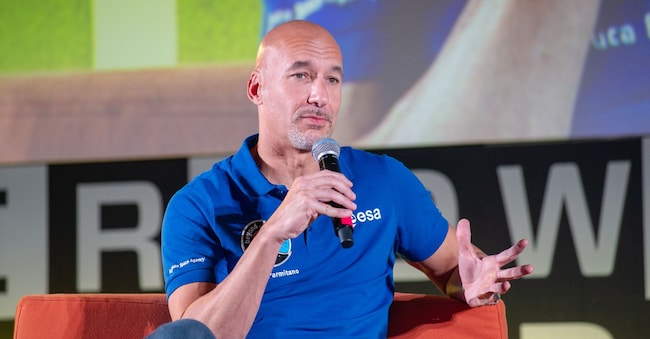
Luna and Parmitano join the Artemis III mission crew

NASA has announced the crew for the next mission in the lunar programme: it will involve four astronauts and the two landers from SpaceX and Blue Origin

by Emilio Cozzi

Luca Parmitano sarà il pilota di Artemis III 7146

5' min read

Translated by AI
Versione italiana

5' min read

Translated by AI
Versione italiana

Luca Parmitano will be the pilot of Artemis III. NASA made the announcement in the late afternoon of Tuesday 9 June in Italia, during a press conference dedicated to the next mission in the lunar programme.

In addition to the European Space Agency astronaut – the first Italian to command the International Space Station and carry out extravehicular activities – the crew includes Commander Randy Bresnik and mission specialists Frank Rubio and Andre Douglas. Parmitano — aged 49, a colonel and test pilot in the Italian Air Force, with 366 days in orbit and two stays on the ISS — will be the first European to hold a primary operational role on an Artemis mission.

Loading...

As the pilot, it will be his responsibility to carry out the rendezvous and docking manoeuvres between the Orion capsule and the commercial lunar landers – the true focus of the mission. It should be made clear straight away that the main objective of Artemis III will in fact be this: not to land on the Moon, but to test the Blue Origin and SpaceX landers – both of which, surprisingly, have been selected – in low Earth orbit. The mission will take place in 2027 and will last approximately 14 days in space, before splashdown in the Pacific Ocean. As reiterated by senior figures at NASA, starting with Administrator Jared Isaacman, the mission will constitute a fundamental technical and scientific building block for the moon landings expected with Artemis IV and V in 2028.

Who are the four

Commanding Artemis III will be Randy Bresnik, 57, a NASA veteran with two missions under his belt and a background as a test pilot in the Marines. Alongside him, in addition to Parmitano, will be Frank Rubio, who holds the US record for the longest time spent in space on a single flight: 371 days on the International Space Station between 2022 and 2023, with a delayed landing because the Soyuz spacecraft he was due to return in had been damaged by a micrometeorite. Artemis III, meanwhile, will mark the debut of Andre Douglas, a 38-year-old naval engineer with the US Coast Guard, who holds a PhD in systems engineering. Bob Hines has been designated as the backup.

Parmitano, visibly moved during his speech from the stage – when he thanked his family and his two daughters for their support – has been in space on the 2013 Volare mission, and Beyond in 2019, and was the protagonist of six extravehicular activities lasting over 30 hours — including one that remains memorable due to a helmet filling with water, and the other four, dedicated to repairing the ‘antimatter hunter’ Ams-2, considered among the most complex in the history of spaceflight. His more than 2,000 hours of flight time across over 40 types of military aircraft and helicopters make him, as ESA Director General Josef Aschbacher said, a testament to the ‘depth of European expertise in human spaceflight’.

Not the moon landing, but a crucial test

As previously mentioned, Artemis III will not take its crew to the lunar surface. Not anymore, at least. The original objective — the first crewed lunar landing since 1972 — has been postponed to Artemis IV, scheduled for early 2028.

Artemis III will be a test mission in Earth orbit, with the aim of demonstrating that the Orion capsule is capable of performing rendezvous and docking manoeuvres with commercial lunar landers.

The first will be Blue Origin’s Blue Moon Mark 2, the vehicle built by the company founded by Jeff Bezos. The other, far more ambitious from a technological point of view, will be SpaceX’s Moonship, a modified version of Elon Musk’s Starship, standing almost 50 metres tall, which has yet to prove it can refuel in orbit – a manoeuvre essential for reaching the lunar surface. Jared Isaacman has explicitly stated that Artemis III is expected to dock both landers in sequence. A dual test, with high logistical risks, but perhaps necessary, given the recent setbacks and accumulated delays.

Two landers, a few problems

On 28 May, a Blue Origin New Glenn rocket exploded on launch pad LC-36 at Cape Canaveral during an engine ignition test. The blast, described as ‘the biggest explosion ever seen’ at Cape Canaveral Space Force Station, severely damaged the launch pad, the only one available for Jeff Bezos’s heavy-lift rocket: the lightning tower was destroyed, the rocket’s transport and hoisting system reduced to scrap metal, and part of the launch pad collapsed into the ‘flame bucket’. It is inevitable to consider the consequences for the Artemis programme: Blue Moon is designed to fly on New Glenn, but many experts argue it will take months to restore the launch pad to full operational capability.

Isaacman has already launched what he has described as a ‘whole-of-government’ response: NASA aims to separate the lander from the carrier rocket and find an alternative launch vehicle — SpaceX’s Falcon Heavy, the only one on the market capable of lifting such heavy payloads, cannot be ruled out.

Not that Starship is without its own set of problems. Although hailed by SpaceX as a major success, the twelfth test of the launch system – the first using the new V3 version – nevertheless encountered an anomaly during flight, and Musk has stated that the next launch attempt is not imminent. What’s more, in-orbit refuelling – the most critical technical aspect of the entire Artemis architecture – remains a capability yet to be proven: SpaceX has announced a test within six months, but the operation has never been carried out under real-world conditions.

Europe at the heart of Orion

There is one aspect that tends to be overlooked in reports about the crew: Europe’s involvement in Artemis III is not limited to Parmitano alone. The Orion capsule’s Service Module, known as ESM-3, is built by European industry under the guidance of the ESA and forms the vital propulsion and life-support core of the capsule in which the astronauts will be housed. It will provide power, propulsion, thermal control, air and water. The module’s structure is manufactured by Thales Alenia Space in Turin; final assembly is carried out by Airbus in Bremen, with contributions from 20 main contractors and over 100 suppliers spread across 13 ESA member states. The module is already at the Kennedy Space Centre, where it has completed acoustic tests and will soon be integrated with the Orion capsule ahead of launch.

For Italia, the picture is even more promising. Minister Adolfo Urso pointed out that Rome holds the chair of the ESA Ministerial Council — the presidency was assumed in Bremen last November — and that last March, in Washington, he signed a bilateral agreement with Isaacman between the Italian Space Agency (ASI) and its US counterpart, involving the construction of the first lunar habitation module (the ‘home of the next moonwalkers’) and the participation of our astronauts in the Artemis programme. Parmitano is the tangible proof of a political and industrial investment that Italia has built up over the years.

The Other Race

Behind it all lies Beijing: China has a crewed lunar programme aiming for a first moon landing by 2030, and it is progressing with a consistency that is hard to ignore. Washington’s stated goal is to get there first, and Artemis IV, with its moon landing scheduled for 2028, is explicitly designed with this in mind.

With a launch pad in disrepair, Starship still far from fully operational and a schedule that has so far been plagued by delays, the inevitable question is how much leeway remains before the West’s supposed advantage dwindles away. Randy Bresnik, Luca Parmitano, Frank Rubio and Andre Douglas will not answer this question. But they are the four people tasked with ensuring it does not become a rhetorical one. After them, the goal will not merely be to be the first to land on the Moon. But to remain on the lunar surface for as long as possible.

Copyright reserved ©

Brand connect

Loading...

Newsletter

Notizie e approfondimenti sugli avvenimenti politici, economici e finanziari.

Iscriviti