
Lvmh drags down the entire luxury sector
The weak recovery in demand, especially in the Chinese market, raises fears that the industry is not at a positive turning point
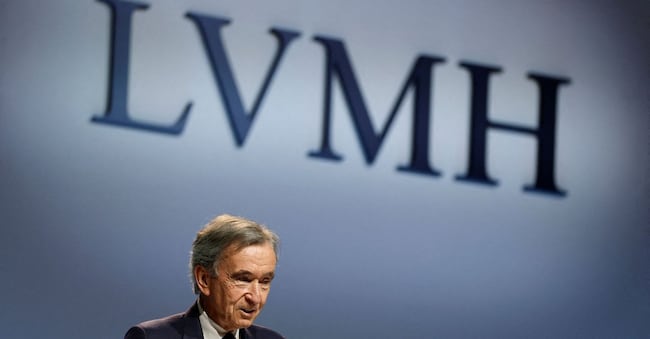
Demand for luxury goods will not recover quickly and the Chinese market will continue to show aspects of fragility despite the recovery in the last quarter of 2025. This seems to be what the results published yesterday by the sector giant Lvmh say, or at least this was the interpretation of the market, which penalised the stock during the session to a drop of over 8%, before ending trading at EUR 545 per share, down 7.63%. Sales infected the entire sector: Kering closed at -3.2%, Hermès at -3.76%, Christian Dior -7.35%, and Burberry -4.70%. Richemont limited its losses, giving up only 1.2%, which is considered best in class at the moment but which has nevertheless posted a negative balance of almost 12% since the start of the year. Among the Italians, Salvatore Ferragamo lost 5.75% after disappointing results for the last quarter, Moncler 2.96%, while Ermenegildo Zegna on Wall Street was down under 3%.
"If the market leader adopts a more cautious stance on the year ahead, this inevitably casts a shadow over the entire luxury sector," commented Carole Madjo, analyst at Barclays. The French group said sales in China increased in the final quarter of 2025, but clearly not as much as investors expected after positive comments on the Chinese market from Richemont and Burberry earlier this month. 'Investors are starting to worry that a recovery in demand would be needed to justify the valuations reached by mid-2025. And at the moment it does not seem imminent,' explains Jelena Sokolova, analyst at Morningstar. There are also those who judged yesterday's market reaction to be overdone, such as Christopher Rossbach, portfolio manager at J. Stern & Co: 'We remain confident that Lvmh's recovery will continue through 2026, supported by creative refurbishments, new retail initiatives and growing consumer demand, particularly from China,' he said.
The fact remains that caution is in order in the face of unclear signals: 'The numbers for the full year 2025 nevertheless point to weak global demand, particularly in the aspirational segment, and not limited to cognac and spirits. Looking ahead to 2026, the potential upside from cost and capital control will be smaller, as a significant part of the work has already been done. The real catalyst for the business and the stock would be a recovery in global demand and a return to revenue growth. A first sign of this has emerged in the second half of 2025, albeit gradually,' writes Luca Solca of Bernstein, adding: 'It remains to be seen whether the trend can be consolidated. If so, and if the base case scenario is confirmed, LVMH could be an attractive investment. On the contrary, if the second half of 2025 turns out to be a false signal and if geopolitical tensions degenerate into an all-out crisis - with a consequent stock market correction - the downside risk would be significant'.


