Finally, in the Selective Retailing segment, organic revenue growth stood at 4% (-3% reported) to EUR 4 billion with Sephora "continuing to post solid growth in all geographies and gaining market share, consolidating its global leadership position". The retail network continued its expansion, particularly in the UK, where the brand has enjoyed strong success. Dfs signed an agreement with China Tourism Group Duty Free to acquire assets in Greater China, notably the Hong Kong and Macau Gallerias; the Los Angeles and San Francisco airport concessions were instead sold to Duty Free Americas. Le Bon Marché continued to pursue its differentiation strategy through an exclusive calendar of events, the group's note said.
Future Perspectives
In detail, in March, Lvmh recorded a drop in demand in the Middle East 'between 30% and 70%', depending on the shopping centres and the different businesses. "On average, the deterioration was 50%," pointed out the financial director, Cecile Cabanis, during the conference call with analysts. At the group level, the top manager explained, 'the overall impact would be about three points in March and one point over the entire quarter'. As for forecasts, 'frankly, I think the outcome is difficult to predict,' she added. 'What we have not seen yet is a repatriation of wealth, and what we do know is that wealth has not disappeared. So there will be a time when we will see it re-emerge, probably elsewhere, and this may mitigate the impact if the conflict continues'. When the conflict started, Cabanis noted, 'shops were completely closed. What we see today is that demand is still very much down. We also have to remember that retail distribution is not uniform: there are shopping centres that are very tourism-oriented, where some brands have shops that used to be in the top 10 or top 20, and these are still strongly affected'.
The most resilient brand is Sephora, 'because Sephora in the Middle East also has a large presence in Saudi Arabia, and Saudi Arabia is now more solid and resilient,' he pointed out. Overall, 'we continue to see a significant drop in demand in tourist shopping centres'.
More generally: "In a particularly complex geopolitical and economic context, aggravated by the conflict in the Middle East, Lvmh remains vigilant but confident at the start of the year. The group remains focused on the development of its brands, underpinned by a constant policy of innovation and investment, as well as an ongoing quest for quality in design, product attractiveness and selective distribution," reads the note from the French group, which concludes: "Lvmh will leverage on the talent and motivation of its teams, the diversification of its activities and the good geographical balance of its revenues to further strengthen its global leadership in the high-quality products sector in 2026."
Analyst Reading
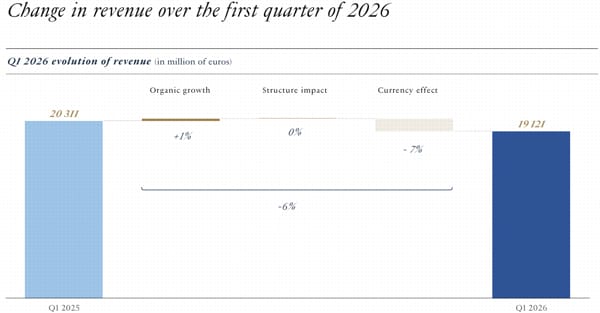
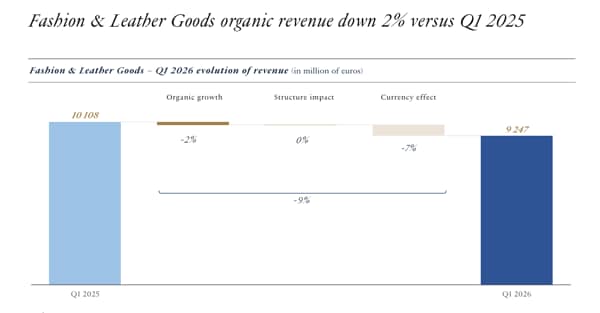
"Lvmh reported a better Q1 2026 update than the Q4 2025 close. However, this may not be enough to convince investors to take a net position. The -2% organic contraction in the Fashion & Leather Goods segment is likely to be a drag, despite the negative impact of around 100 basis points related to the Middle East (in line with expectations: Global Luxury Goods: A deep-dive into the Middle East)," write Bernstein's analysts, who continue: "We believe Louis Vuitton has never been a problem and continues not to be, while Dior is undergoing a revival - albeit more pronounced in Western markets than in China - under the new creative direction of Jonathan Anderson. Having overcome the unfavourable base effect linked to the collaboration with Takashi Murakami and with a gradual strengthening of Dior's momentum, we expect the second quarter of 2026 to be the moment when the F&LG division will return to positive organic growth. Provided, of course, that the geopolitical environment - between the Trump administration's policies and tensions in the Gulf - does not introduce further elements of instability. On the currency front, the exchange rate effect had a negative impact of about 700 basis points on revenues'.