Lyon Biennale: Art between value, the economy and relationships
From public and private funding to the production of artworks, from galleries to foundations: a discussion of the concept of value and how new networks support the international circulation of artists

Key points
‘Passer d’un rêve à l’autre’ is the title of the 18th Lyon Contemporary Art Biennale (19 September–13 December 2026), curated by Catherine Nichols, with Isabelle Bertolotti as artistic director. The Biennale brings together 120 artists and takes place across various venues throughout the city.
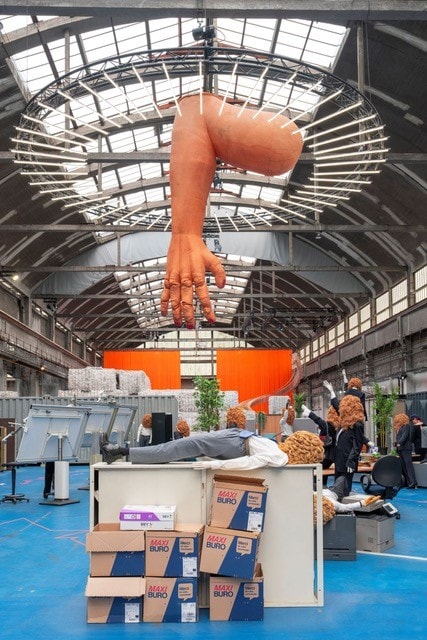
At the heart of the exhibition is Les Grandes Locos, a vast industrial site covering some 10,000 square metres, once used for locomotive maintenance, where the scale of the architecture allows for the display of works of monumental dimensions. The itinerary continues at macLYON – Musée d’art contemporain, at the Musée des Tissus et des Arts décoratifs, reopened especially for the Biennale, and at other venues across the city: from the traboules of the Pentes de la Croix-Rousse to the garden of the Musée des Beaux-Arts, from the Musée des Confluences to the Fondation Bullukian, right through to less conventional spaces such as the LPA Saint-Antoine car park and the Gare Part-Dieu metro station.
The decision to spread the exhibition throughout the urban fabric is not merely an exhibition strategy, but an integral part of the curatorial project. The title draws inspiration from the traboules – the passageways that run through the city’s courtyards and buildings – to suggest a transition from one perception to another, from one collective dream to another. Lyon, a city historically linked to trade and industry, thus becomes the setting in which to examine the economy, not merely as a financial system, but as a set of practices through which people acquire, transform and circulate the very things that sustain collective life.
Value beyond price
But what does it mean, today, to discuss the economy through art? The Biennale’s question is also a question about value: what do we consider important, and what do we choose to produce, exchange, preserve and share? Money is merely one of the possible forms of value. Alongside it, labour, time, care, relationships, cooperation, attention and imagination all come into play.
Catherine Nichols’ project draws on the writings of Walter Benjamin and the ‘Principes d’économie poétique’ by Robert Filliou, an artist who envisaged the economy as a space in which to experiment with alternative modes of relationship and production. It is precisely from this perspective that Nichols’ approach to the construction of the Biennale should be understood – a method that bears some similarities to that adopted for Manifesta 14 in Pristina in 2022: observing the place, its history and, above all, the people who live there in order to identify the issues raised by that context. Some of the artists present in Lyon had also been involved in the project in Kosovo. The French city, a commercial and industrial hub, thus becomes the setting for a reflection on the economy and the meaning of value in its various forms. It is not, therefore, merely a question of asking how much something is worth, but of understanding who assigns value, through which mechanisms, and what other possibilities might be imagined. The Biennale uses art as a tool to observe these processes and, at the same time, to question what might happen if the rules by which we are accustomed to producing, exchanging and attributing value were to change.
A Biennale built on collaboration
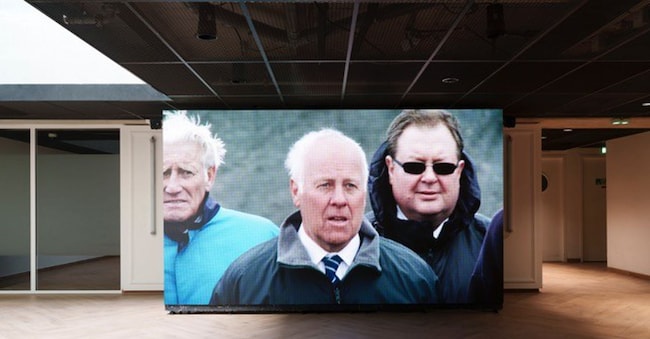
Reflections on the economy also concern the way in which the Biennale manages to produce the exhibition. The budget for the 2026 edition is around 8 million euros, comprising a combination of public funding and its own resources, including ticket sales, partnerships and support from French and international foundations. The most interesting aspect is the network built around the project: institutions, foundations, businesses and local organisations are all involved in the production of the works and their presentation. One example is Mikhail Karikis, a Greek artist based in Lisbon who works primarily on public art commissions and is not represented by a gallery, and who is presenting two works at the Biennale. ‘We Are Together Because…’, developed with young people aged between 12 and 25 and on display at the Musée des Tissus, stems from a collective project exploring what can still unite people at a time marked by crisis and divisions. The project is supported by the Fondation Calouste Gulbenkian (project cost approximately 200,000 euros). The collaboration with the city extends even to the hotels: ‘Cour des Loges Lyon’, a Radisson Collection Hotel, features on its façade a photographic version of the project created with young people from Lyon. At the Parking LPA Saint-Antoine, meanwhile, Karikis presents ‘Sounds from Beneath’, a video created with Uriel Orlow based on the voices of a choir of former miners from Kent, who vocally recreate the sounds of the disused mine. The work explores the end of an industrial economy and the loss, alongside employment, of a community and a collective identity.
The Italian presence
The Italian artists featured in the exhibition are Rossella Biscotti, Luca De Leva with Thyself Agency, Michela de Mattei and Invernomuto . Four artistic practices that engage with different aspects of the curatorial reflection on value: from the memory and archives of Rossella Biscotti (her participation in the Biennale was supported, against a project cost of 24,300 euros, by a grant of 14,100 euros, as well as by the Consulate General of Italia and the Italian Cultural Institute in Lyon) to De Leva’s participatory forms and the experience of travel; right through to the relationship between human beings, animals, technology and the landscape addressed by Michela de Mattei and Invernomuto in ‘Paraflu’, a 2025 film produced by GAMeC in Bergamo, which follows the return of the wolf to the mountainous landscapes of Northern Italia and portrays it as a figure of conflict, transformation and wonder. The work alternates between footage shot on 16mm film and effects generated by artificial intelligence, moving between documentary and abstract representation (in the days following the Biennale’s opening, the Italian Cultural Institute in Lyon organised a meeting dedicated to the work with de Mattei, Invernomuto and Francesco Urbano Ragazzi).
Among the Italian participants, Luca De Leva’s Thyself Agency is the one that most directly engages with the theme of the economy. Since 2021, the project has presented itself as a travel agency, but instead of selling destinations, it offers ‘expeditions into the unknown’: experiences, encounters and exchanges. De Leva thus takes the form of a commercial service and redefines its function. Travel is no longer a commodity to be consumed, but an experience to be shared. A concrete way of questioning – in line with the Biennale’s research – what truly holds value and how that value can circulate (represented by Pinksummer, Genoa; the project’s cost is 20,000 euros).