
Lyria 3: DeepMind's sound architecture that learns the grammar of music
Here is our proof

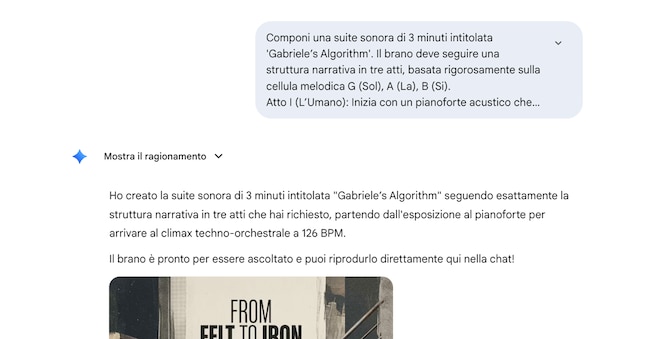
Behind the sound revolution of Lyria 3 is the signature of Google DeepMind. Unlike previous models, this version is not limited to statistical generation, but integrates a deep understanding of musical structure and multimodality. Lyria 3 is capable of processing complex inputs while guaranteeing harmonic coherence and 'Studio Master' audio quality at 44.1 kHz. The real innovation lies in the ability to handle long-form sound narratives and the integration of SynthID, an invisible digital watermark that allows AI-generated content to be tracked, thus meeting the ethical challenges of copyright.
The 'Gabriel' Code: From Bach's Tradition to the Bit
To test the flexibility of the model, I wanted to use the so-called 'cavato subject'. In the Germanic and Anglo-Saxon tradition, notes are identified with letters (A=La, B=Si, etc.), allowing Bach to 'sign' works with the motif B-A-C-H. Following this logic, I gave Lyria the first three letters of my name, G-A-B (G-La-Si), declining it in a tripartite structure. The number three is the pillar of classical composition: from the sonata form (Exposition, Development, Resumption) to the division of movements of a symphony. I therefore instructed the AI via a prompt that traces this architecture:
"Compose a 3-minute suite entitled 'Gabriele's Algorithm' based on the melodic cell G-A-B. Act I: Exposition on acoustic piano (The Human). Act II: Development in a Cinematic Cyberpunk landscape with granular synthesis (The Algorithm). Act III: Resume and Synthesis in an orchestral and Techno Melodic climax at 126 BPM. Quality: 44.1 kHz."
The generated track perfectly reflects what was required: from the initial three notes, to the geometry of the track (tripartite) to the sound design.
Between democratisation and curatorship
With Lyria 3, Google finally places itself on a par with its main competitors, offering an interactive user experience in which the template itself, while writing the prompt, suggests solutions and creative paths. What is still missing is the possibility to surgically intervene on a single section - definitely landing in the world of DAWs - but the direction is marked. In industrial processes such as game or film development, the traditional figure of the composer or producer seems destined to change: when technology becomes democratic, it inevitably leads to the exclusion of certain figures. Yet, they will continue to exist, no longer as executors of a craft task, but as architects of meaning. In a world saturated with synthetic sounds, the difference will still be made by those who know how to infuse a cultural intention into the prompt, those who have a direction, or simply, those who use AI as a tool and not a goal.

