
Maccarese celebrates 100 years: always the territory at the centre

3' min read
3' min read
The history of Maccarese is a history rich in projects, ideas, leading figures in politics and economics, but also and above all in the lives of the many workers. Women and men who, from the end of the 19th century until the 1940s, arrived from different parts of Italy, often fleeing from extremely difficult economic conditions, to start a new life in an area that until then had been almost uninhabited. A complex process of anthropisation that, among other things, would influence the identity of the company, destined to become a strong national reference point for trade union struggles after World War II. The entrepreneurial, political and social dimensions are in fact inextricably intertwined in the history of this company and this territory. From the liberal state's commitment to reclaiming the countryside around the new capital of the Kingdom, to the long controversy over the legitimacy or otherwise of taking on social objectives beyond the mere profit and loss account, to the great resonance, including in the media, that accompanied the privatisation process. This is why the events of Maccarese take on a political and social importance that goes far beyond the local and sectorial fact and become, on the contrary, paradigmatic of a century of Italian life.
At the origins of the 'Maccarese' project, in the early 1920s, there was a convergence between the interests of northern financial capital, liberal and reformist ideas and public policies. The objective of the investors, primarily the Banca Commerciale and Credito Italiano, was to reclaim the land, start farming activities and resell the property by cashing in the proceeds from the revaluation of the land. However, in the years of the 'battle of wheat' and 'quota novanta', the prices of agricultural products and land property fell drastically and the initiative that had started out as a financial institution took on an agrarian industrial character, ending up, in the early 1930s, under the control of Iri. Then, with the advent of the democratic republican state, themes and perspectives changed radically, but the attempt to reconcile capitalist enterprise and social aims remained. This led to the 1980s, when it became an increasingly widespread conviction that a public company could not take on social burdens and the process of divestment began, which would only end in the late 1990s, when the company was acquired by the Benetton group, thus avoiding a state of crisis.
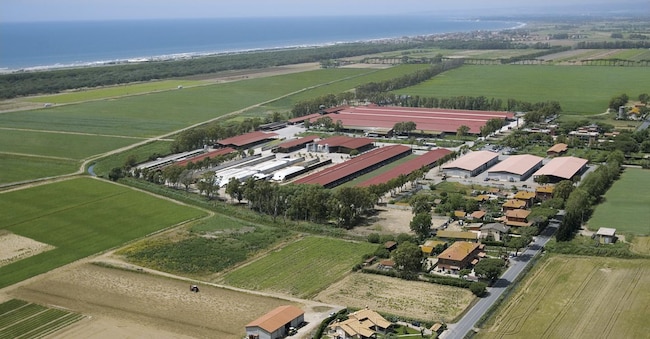
Maccarese - which covers just over three thousand hectares within the Litorale Romano State Reserve - has now become one of Italy's largest agricultural companies, with over 60% of its turnover generated by livestock activities, and has maintained a social vocation, not only because it has adopted the status of a benefit company, but also because it continues to focus its activities on caring for the local area, supporting the growth of young people, and enhancing the value of skills, elements that are considered fundamental by the parent company Edizione.
One hundred years after the birth of Maccarese, this volume welcomes contributions from academics such as Lidia Piccioni (La Sapienza University) and Andrea Colli (Bocconi University) and scholars from different backgrounds and perspectives (Riccardo di Giuseppe, Paolo Isaja, Francesca Ghersetti, Susanna Oreffice, Nicoletta Paterno, Alessandra Benadusi, Simone Bucri and Maria Pia Cedrini), raising significant and extremely topical questions. Albeit within a profoundly different historical and economic framework, the fil rouge linked to the relationship between capitalist enterprise and collective well-being, as well as between economic development, territory, environment and quality of life, seems to re-emerge in the present. In this sense - as the former Minister of Agriculture, Maurizio Martina, writes in the book's preface - the long history of Maccarese, the result of historical, environmental, economic and social stratification, also opens up important questions about the future: from the challenges posed by food, to the emergencies linked to the climate and biodiversity, to the very sustainability of the capitalist model and the effectiveness of the new social responsibilities assumed by companies.
PhD in contemporary Italian history, psychologist and independent researcher.

