
"Machines are getting out of hand. Man is in danger'
Kate Burns, the woman who made Yahoo! and Google great, sounds an alarm about the 'artificial' future: 'Young people don't know what to believe anymore'.
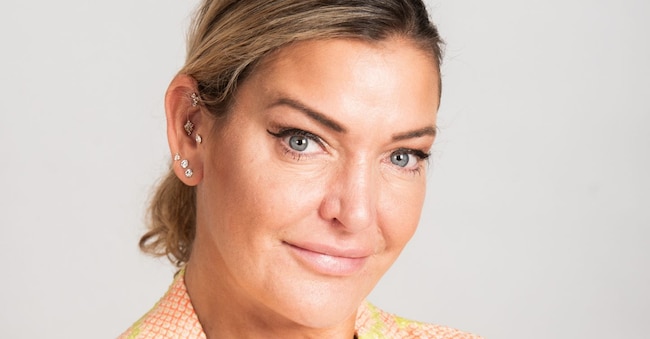
7' min read
7' min read
In the global meat grinder of social media, a video had surfaced one morning some time ago ofDonald Trump and former friend Elon Musk visiting a Palestine turned into a huge tourist resort. That it was a fake was easy enough to 'spot'. Much less so, however, what Trump published months later: former president Barack Obama is arrested by the FBI who throw him in jail: not true but so realistic that many people fell for it. Italy, however, has the solution to hoaxes. It is called IdentifAI and it has an exceptional guide: the tech lady Kate Burns, Canadian but, she exclaims, "I feel pan-European now".
Italy has the medicine against fakes on the internet
IdentifAi is an innovative company founded just a year ago, in Milan: it was set up by Marco Ramilli and Marco Castaldo. Ramilli is a former executive of Tinexta, a Roman digital group, with a past in computer security also for the US government. The idea of an intelligent programme that recognises deepfakes, sophisticated fakes, had come to him two years earlier, on the day in March 2023 when the social media was invaded by an unusual photo of Pope Francis: the late Bergoglio was wearing a Moncler down jacket. It was a blatant fake. If one Marco is the man of technology, the other Marco, Castaldo, is the man of numbers: he worked in Azimut, the asset management company, and in the financial giant Credit Suisse. As soon as they started out, they immediately raised over EUR 2 million and after not even a year, in the height of summer, they closed a second round of financing of EUR 5 million, orchestrated by United Ventures, the fund of Massimiliano Magrini, a technology guru, and Paolo Gesess.
The woman who lived many lives (on the web)
.The next move was to call Burns 'Wonder Woman'. The 50-year-old dresses in a casual-elegant manner, with a touch of eccentricity from her many rings, bracelets and necklaces: 'I have a degree in Linguistics,' she began when asked about her background. From linguistics to artificial intelligence it seems like a 'career by chance' and instead it is a kind of pre-destiny. She was born in Ontario, the Toronto province of the Niagara Falls: as a child she dreamed of being an actress, like all little girls. Her parents had other aspirations, as all parents do. 'They hoped for a future as a lawyer, in the end we found a middle ground with linguistics,' she recalls snickering. She has many lives behind her: she is sitting at a table on the roof terrace of the Soho House in London, poolside, overlooking the church ofSt. Mary-Le-Strand. London is Kate's adopted city: the Burns family, of distant Mediterranean origins, moved from Canada to the UK in the late 1970s. When she speaks, she reveals a typically North American way of thinking and cultural substratum. His professional life has unfolded between start-ups, from one pioneering technology project to the next, each time as improbable as it was revolutionary. And she has always escaped at the edge of success, before the unicorn on duty took the leap. She is as American, indeed Californian, indeed Silicon Valley, as one can imagine. After graduating from the University of Birmingham, she got a job at The Sun, the famous British tabloid that mixed more or less questionable scoops with the very popular third page, the one with bare-breasted women: it was one of the country's best-selling newspapers in the 1970s and 1980s. She had to deal with advertising sales, the furthest thing from a degree of compromise with her parents. But more than the coarseness of the newspaper, the real obstacle is the owner: Rupert Murdoch. The Australian tycoon had bought the newspaper in 1969 and the nickname 'The Shark' was not an exaggeration: 'He was almost always away on business, but when he was there he was a terrifying person,' he says. The offices of Newscorp had six floors: 'Ours was a boiler room (literally the 'boiler room' but it is an expression to indicate fraudulent activities, bordering on legality, Ed)'.
Magazines and tape cassettes
For young Kate, these are years of apprenticeship that teach her a lot about the world of advertising. But the real turning point for her will come with IT: she leaves Murdoch and lands at Ziff Davis. It is a historic American publishing house, founded in the early 1900s, and publishes many hobby magazines. In the 1980s, however, a new hobby appeared on the market: the personal computer. The first Commodore 64 arrived in homes and Ziff Davis launched a computer magazine: it was called PC Magazine and quickly became the industry bible. "They were looking for people to test something called the Internet, which nobody had heard of," he recalls today, laughing. He accepted the proposal but in the meantime the department where he works invented a revolution for the magazine industry: the editorial coupling. Taped to the cover of PC Magazine was a cassette with programmes inside. It became a worldwide success, copied by everyone. Years later, the commercial model also arrived in Italy with Panorama and l'Espresso giving away the film of the week. At the time of PC Magazine, Kate's destiny was not marked by commercial ventures, but by a paperon who sat at the top: the Ziff Davis group "at the time was owned by the Japanese Softbank" which in turn had been founded by a then semi-unknown Japanese gentleman: Masayoshi Son. The entrepreneur would become one of the world's super-magnates (today he has an estimated wealth of $45 billion). When Kate was working at the publishing house, Softbank's investments included a majority stake (51%) in a very strange computer start-up called Yahoo!. Son asked her to find a way to make money with that company with the strange name and even stranger business. "We came up with the idea of putting advertisements on the Home Page, which was a static page". Without knowing it, Kate invents banners, advertising on the Internet. It is the dawn of a new era, but young Kate will not capitalise on the huge revolution: 'I had Yahoo! shares but left the company before the internet boom and before the listing'. She misses the chance to become an ultra-millionaire at less than 30 years old, but she will have other satisfactions. Shortly after her farewell, she was called upon to lead all the European activities of Altavista: it was the competitor of Yahoo!, another web pioneer and long gone. 'Very young, I become head of an entire continent'.
An unknown company called Google
.He will remain there only a short time because after three years, another call comes, again from the United States: 'It's another start-up, they have been looking for a person to manage Europe for some time. Never heard of them before: they are called Google and I discover that they are a sort of Yellow Pages on the web'. Today, Google is the lord of the web, but she has never made any concessions, not even at the beginning: 'The job interview lasts 10 hours, it is a very tough test, where I also meet Larry Page who hires me. She became the first woman, in the entire, even future, history of Google, to head the International division covering the whole world. At the time, however, she was less than nothing: 'I had to set up Google's entire worldwide business but they gave me no support: I was alone working, in an office room in Soho, where I also slept'. Kate is a steamroller and after six years, Google International has hundreds of employees and the European division, which she heads, becomes the largest geographic area, in terms of revenues and profits, after the United States. When the two brainiacs, Larry Page and Sergei Brin, fly to London for the first time, to visit their European offices, they ask Kate to take them to the British Museum to see the Rosetta Stone, the tri-lingual inscription that made it possible to decipher Egyptian hieroglyphics. In the end, that degree in linguistics had not been so useless: 'Human language works like an algorithm, the mental and logical structures of languages are similar to the calculation models of a computer,' she comments. In the meantime, Kate also becomes a mother of two: in theory she has everything, success at work and family. But she feels that something is wrong: 'After the IPO, Google's corporate culture had changed and I didn't like it any more'. So, after seven years at the top, it is time for a new farewell to accept an opposite challenge: to restore a sick company. He arrived at AOL Europe: America On Line had been the largestinternet service provider in the United States (the famous ISP, access resellers) at the time of the New Economy, with 30 million subscribers. She was then taken over by the media giant Time - Warner: 'I find myself having to close divisions and lay off hundreds of people'. But she also succeeded in that: she turned the company into a digital publisher, with the acquisition of the online newspapers Huffington Post (English and Spanish editions, the Italian one belongs to GEDI group of John Elkann) and TechCrunch. The story of Mrs Burns has marked all the stages of the digital revolution of the last 30 years.

