Towards government

Macron to France: 'Build a solid majority'

In a letter to the citizens, the president calls for building a coalition of all Republican forces that together have obtained an 'absolute majority'.

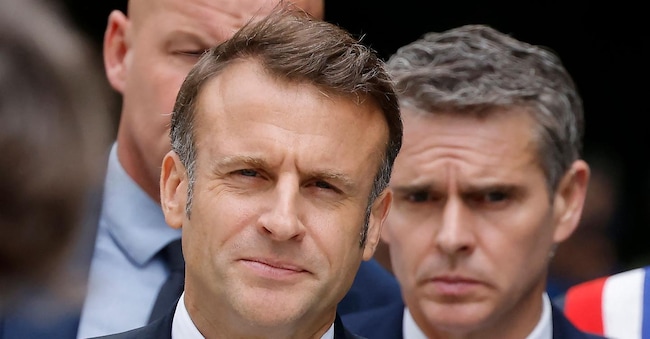
Il presidente della Repubblica francese Emmanuel Macron

4' min read

4' min read

'Nobody has won'. Emmanuel Macron breaks his long silence and entrusts to a letter sent to the regional press the invitation to open a new political season, marked by the need to create coalitions between different parties - as happens in other countries but not, so far, in France - but also to carve out a new institutional role for himself.

Minority all political forces

"No political force has obtained a sufficient majority and the blocs or coalitions that emerge from these elections are all minorities," the president wrote after recalling that the extreme right reached "almost 11 million votes" and that "you have clearly rejected it coming to government".

Loading...

The Republican 'absolute majority' camp

.

The president's conclusion is then that 'only the republican forces', those who participated in the desistance agreements, which therefore take on a political value and do not remain an electoral tactic, 'represent an absolute majority'. The political consequence is immediate: 'The nature of these elections, marked by a clear demand for change and power-sharing, forces them to build a large grouping'.

President 'guarantor'

.

As President of the Republic, Macron added, evoking the dictate of the Constitution, "I am both protector of the Nation's supreme interest and guarantor of the institutions and of respect for your choice". The invitation, addressed to 'all the political forces that recognise themselves in republican institutions, in the rule of law, in parliamentarianism, in a European orientation and in the defence of French independence' is to 'engage in a sincere and loyal dialogue to build a solid majority, necessarily plural, for the country'.

"Ideas before people"

.

"Ideas and programmes before posts and personalities", is the president's request: we need "some clear principles for the country, clear and shared republican values, a pragmatic and comprehensible project" that "takes into account the concerns you have expressed".

still a long time

.

Macron will choose the prime minister 'in the light of these principles'. Not immediately, then: 'This presupposes giving the political forces time to build these compromises with serenity and respect for everyone. From here and until then the current government will continue to exercise its responsibilities then it will be in charge of current affairs as the republican tradition dictates'.

"A new political culture"

.

'Last Sunday,' the letter concludes, 'he called for the invention of a new French political culture. I will watch over this. In your name, I will be its guarantor'. With a somewhat paternalistic approach, which is, however, part of the DNA of French semi-presidentialism, Macron wants to prevent the result of the 2024 elections from just buying some time against the rise of Marine Le Pen's illiberal right and, without evoking it, Jean-Luc Mélenchon's radical left. For himself, he carves out a new task, written into the Constitution, but soon forgotten in a process of progressive 'presidentialisation' of the system: that of overseeing 'respect for the constitution' and ensuring 'by acting as arbiter, the smooth functioning of the public powers'.

Ensemble MPs with Attal: broad coalition

The president's letter was preceded by a stance by Renaissance's elected representatives, on X, in favour of 'a project coalition ranging from the social democrats to the right of the government', and excluding La France Insoumise. The elected representatives thus decisively inserted themselves into the dispute between Prime Minister Gabriel Attal, in favour of a broad coalition, and Interior Minister Gèrald Darmanin, who was instead aiming - with the support of Economy Minister Bruno Le Maire in particular - for an agreement with the Républicains alone, on the right.

Horizons calls for Hollande's intervention

Renaissance's allies are also starting to open up to the idea of a broad government: the president of the Horizons group, Laurent Marcangeli, called on former president François Hollande to create a 'very temporary agreement that could last until next year' that would start with the Gaullists and reach out to the social democrats, although 'talks can also be opened with the Communist Party and the ecologists'. "You cannot make a government of national union with one camp," added MoDem leader François Bayou.

The Gaullists' anxieties

The president's letter thus somewhat truncates attempts at agreement limited to the right. Among the Gaullists, Xavier Bertrand and Bruno Retailleau had also declared their willingness to ally with the Macronians, provided the government was led by a Républicain, while Laurent Wauquiez, elected president of the parliamentary group 'Republican Right' was much more rigid: "For us, there will be neither coalition nor compromise," he said before the publication of the president's letter. "We will not participate in government coalitions," he added: "We do not believe that one can respond to a country's crisis with a combination of apparatuses."

The Left comes to terms with the reality of voting

.

The Left, which has not yet expressed a name for the post of prime minister, is meanwhile beginning to realise that it will not be able - for reasons that are not only technical but also political - to govern by means of decrees and recourse to Article 49.3 of the Constitution (which on certain matters allows avoiding a parliamentary vote. Consequently, it will not be able to govern alone, even if this consequence has not yet been explicitly admitted.
The ecologist deputy Sandrine Rousseau said that the Front should commit itself not to use 49.3, in fact challenging the opinion of the socialist secretary Olivier Faure, according to whom 'what was done with 49.3, can be abrogated with 49.3' (the reference is to the pension reform). Raphael Glucksmann - now somewhat isolated after his success at the European elections at the head of a socialist coalition - also recalled that 'you cannot govern with decrees and 49.3'.

Mélenchon: no clash with the EU

In the radical left camp, France Insoumise founder Jean-Luc Mélenchon responded harshly to the president's letter, saying that Macron 'refuses to recognise the result of the ballot box' and explaining that he should 'bow down' to the Nouveau Front Populaire. Mélenchon is softening his positions, especially in the fiscal field: he said that the Nouveau Front Populaire 'has no interest in a head-on clash' with the European Union over the stability pact and that the costs of his programme's measures will be covered by 'higher revenues': 'We are quite capable and intelligent' to understand this, said Mélenchon

Copyright reserved ©
Loading...

Brand connect

Loading...

Newsletter

Notizie e approfondimenti sugli avvenimenti politici, economici e finanziari.

Iscriviti