Permanent innovation laboratory

The Italy of tomorrow at Mad for Science

Between orientation to Stem careers and the need to form a scientific citizenship.

by Irene Bozzoni* and Ruggero Pardi**

4' min read

4' min read

"It's like an Olympic final". This is how the final day of Mad for Science was described, the science competition dedicated to high schools that rewards talent, commitment and creativity every year. An event that, in the words of those who experienced it from close quarters, restores the certainty that there is a great value in our country, capable of generating hope. Because seeing girls and boys so motivated, competent and passionate shows that the Italy of tomorrow is already among us.

The importance of Stems

.

Today, our country suffers from a worrying delay in STEM (Science, Technology, Engineering and Mathematics) education: the number of graduates in scientific disciplines is among the lowest in Europe. And among those few who choose this path, many find themselves, after years of study and sacrifice, faced with uncertain and unrewarding job prospects, often forced to seek recognition abroad that they do not find at home. The brain drain is not just an individual loss: it is a collective damage, a brake on our ability to innovate and produce knowledge, to face the challenges of the present and the future.

Loading...

Scientific Citizenship

.

Yet, alongside the issue of orientation towards scientific careers, there is another fundamental aspect that cannot be overlooked: the need to form a scientific citizenship. In an era in which individual and collective decisions are increasingly linked to science and technology, every citizen should have access to cultural and methodological tools to understand the reality around him, evaluate sources, and reason critically.
The problems on the table

.

All this suffers from two structural problems: on the one hand, the chronic lack of resources for education and research; on the other, the absence of long-term planning, of an investment that lasts. Yet, virtuous examples such as Mad for Science show that when space and trust are given to students and teachers, the results come.

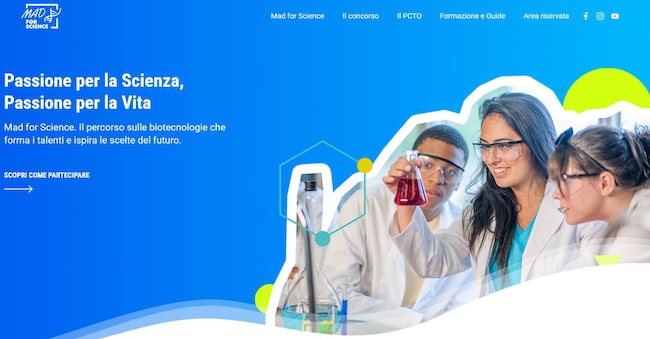
The numbers speak for themselves: 140 participating schools, eight finalist teams, hundreds of projects presented in nine editions. A network that is consolidating and sharing experiences, ideas, improvements. A permanent laboratory of educational and cultural innovation.

Evaluation of Excellence

.

To date, Mad for Science has involved more than 600 schools throughout Italy, activated more than 450 collaborations between institutes and research organisations, completely renovated 16 school laboratories and awarded EUR 1.5 million in prizes. It is recognised by the Ministry of Education and Merit as a project for the enhancement of excellence and is accompanied by ongoing training initiatives such as Mad for Science for Teachers and A tu per tu con la Ricerca, which consolidate a model of participatory and aware scientific citizenship.

Being a juror in the Mad for Science competition is, every year, a privilege and a responsibility. A privilege, for the opportunity to witness the birth of innovative, profound, authentic ideas. A responsibility, because selecting the best projects from among such high-level proposals requires attention and expertise. The 2025 edition of the competition, dedicated to the themes of health, environmental protection and the circular economy, exceeded all expectations, giving us an encouraging picture of the scientific potential of young Italians.

Innovative ideas and projects

.

The best projects developed by the students of the eight finalist high schools were not limited to laboratory exercises: they were real research paths, tackled with creativity, method and rigour. We saw innovative ideas for health monitoring in vulnerable contexts, studies on useful microorganisms, eco-sustainable materials made from food waste, and experimental technologies for soil purification. All united by an interdisciplinary, ethical and future-oriented approach.

As scientists, we know the qualities needed to stand out in the world of research: passion, insatiable curiosity and proper mentorship. And it is precisely this winning triad that we recognised in the competing teams. Young people full of enthusiasm, able to ask intelligent questions, to critically review their work, to question themselves. And behind them, passionate teachers who knew how to accompany without directing, facilitating the active participation of the young people. The social role of these lecturers is immeasurable: from them come the guidance and inspiration from which the scientific careers of the brightest students sprout.

A strategic vision is needed

.

The success of Mad for Science, however, cannot remain just a happy exception. We must grasp the message coming from these students: Italy has talent, it has energy, it has extraordinary intelligences. But we need a strategic vision to make the most of them.

Events such as Mad for Science show that talent is there, but must be nurtured. There is a need to strengthen school orientation towards scientific careers, to concretely support laboratory teaching, to invest in educational infrastructure and, no less important, to contribute to the training and development of deserving teachers.

To all participants, current and future, we want to say: keep searching, keep asking, keep observing the world with curious eyes. Science is not just a career: it is a key to understanding reality in order to become aware citizens. And to those who are responsible for governing schools, universities, research: we can no longer afford to lose these talents. Let us take advantage of the current context to give them the tools, resources and opportunities to stay and to contribute to progress. Because Italy's future - including its economic, social and cultural future - depends on its ability to believe in young people and in science. Mad for Science has shown us, once again, that the future is already here. It has the enthusiastic face of girls and boys who know how to observe, analyse and imagine solutions. Our responsibility is to give them the chance to realise them, because this is the real Made in Italy.

* Irene Bozzoni is Professor of Molecular Biology at La Sapienza University of Rome and Senior Researcher at the Italian Institute of Technology

** Ruggero Pardi is Professor of General Pathology at the Vita-Salute San Raffaele University of Milan

Copyright reserved ©
Loading...

Brand connect

Loading...

Newsletter Scuola+

La newsletter premium dedicata al mondo della scuola con approfondimenti normativi, analisi e guide operative

Abbonati