
'Made in Italy and a sartorial approach make our hotels unique'
The president and CEO of Starhotels recalls her beginnings in New York and her commitment to showcasing and telling the story of fine Italian craftsmanship

After a visit to the Sistine Chapel in 1990, Dr. Frank Lynn Meshberger of St. John's Medical Center in Anderson, Indiana, published an article in the Journal of the American Medical Association that caused a stir in the medical and art worlds. He theorised that Michelangelo had thus wanted to represent God's most precious gift to his most sophisticated creature: the mind, with its mechanisms and mysteries. "One paints with the brain, and not with the hands," Michelangelo himself noted.
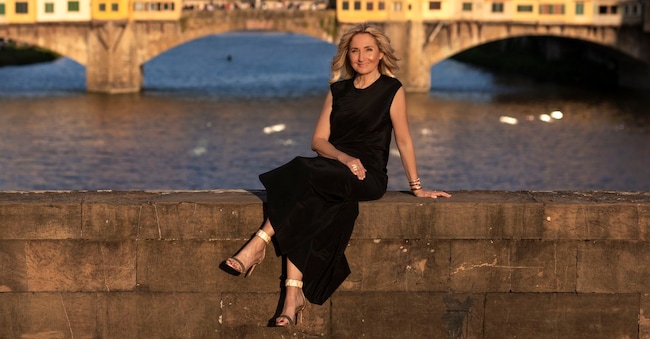
Jumping across centuries and places, and arriving in the New York of the early 1990s, the act of observing ignited a crucial creative spark in a young Italian businesswoman on the move: 'I had told my father that it was time to expand abroad and buy a hotel there. He took me for a bit of a fool, but in the end he gave me confidence. We had taken over a hotel that up to then had been run by Chinese entrepreneurs, who had furnished it with, shall we say, unremarkable taste. I decided to renovate it with a more Italian approach, and we christened it The Michelangelo": this is one of Elisabetta Fabri's fondest memories of New York, president and CEO of Starhotels, the hotel group founded in Florence by her father Ferruccio in 1980, of which she has been at the helm since 2000. In recent years she has taken the hotel abroad and made it the leading independent hotel in Italia in terms of turnover, with 315 million in 2024, 34 hotels and 4,500 rooms. And it was there, in that hotel that immediately spoke of Italianness, that Fabri had his vision of the future: "When the Americans realised that I lived between New York and Florence they would say to me "what a life!", a comment that made me realise how much they loved Italia, and that opened my eyes: I had realised for the first time the privilege of being Italian - he recounts -. From there, I realised that there was incredible potential in enhancing our vision, our connection with our cities, our art, our personality. And since then I have approached every hotel in this way, also giving space to my original passion for architecture. I started with the Tuscany, taking over the former Monginevro hotel that Lancia had opened near its factory on the outskirts of Florence. It was terrible. We incorporated authentic Tuscan elements, terracotta pots, straw, leather, a palette of sage green and copper. After 21 years it is still very fresh, very contemporary'.
This is how Elisabetta Fabri put her interpretation of her father's intuition, who wanted to create an almost industrial, highly codified system of hospitality. The very name 'Starhotels', in fact, evokes a precise list of 'standards': 'On the front everything respects and interprets the genius loci of a place, but behind it there are very precise industrial processes. And everything works so well that the customer does not notice. We have a large head office in Florence with 150 people, but our approach is always sartorial. Cut and paste is easy, but it doesn't work. Look around you'.
We are in the penthouse suite occupying the top floor of the Hotel d'Inghilterra, a landmark address in Rome since it opened in 1845, between Via Condotti and Via Borgognona. Starhotels bought it, redesigned it and renovated it to its sartorial standards. There is the original 19th-century fireplace, bas-reliefs by Felice Calchi, lamps from the Vetrerie Empoli, and fabrics created by Rubelli elaborating motifs that recur in the hotel. "This place has always been a sort of home, with a long history, a precise soul. We have respected the artistic spirit of the city, working with the beaters of the historic centre, and called in Paolo Antonacci, heir to one of the oldest Roman families of antique dealers, as a consultant. Do you see these painted doors? We recovered them, they had suggested we get rid of them. In reality we do not throw anything away, on the contrary: in a 2,000 square metre warehouse we keep the furnishings or elements that we do not need, but perhaps we will recover later'.
The valorisation and narration of high craftsmanship in Italia also passes through another of the company's standards, codified by yet another intuition, born of observation, of Fabri: 'Living in Florence, I realised how much craftsmanship was neglected. Today it is a very popular topic, a world that is seen and protected, but until a few years ago the workshops were closing one after the other. In 2019, I decided to make my contribution, with the 'La Grande Bellezza' project, together with the Fondazione Cologni dei Mestieri d'Arte and Gruppo Editoriale, to bring the creations of this savoir-faire to our hotels all over the world, becoming its ambassadors. For our hotels, we try to buy made in Italy products as much as possible, even from small companies and for minor objects: for umbrellas, I remember that it was very difficult to find someone who still knew how to make them. We also organise a biennial competition reserved for Italian craftsmen, to whom we propose a theme, this year it is 'the beauty of the useful'. Many entries were received, and we will give the winner the opportunity to exhibit his creations, we will buy them, and we will also reward him with 10,000 euros, to contribute to his future projects'.


