
Textural effects and thin slabs, made in Italy dictates the line
The industry raises the design bar and focuses on technology to continue dominating the premium end of the market

4' min read
4' min read
In 1968 Dick Fosbury won the high jump gold medal at the Mexico City Games and revolutionised sport with his back landing. It's a good story: by changing the rules of the game you can radically innovate the meaning of a product, be first again. In response to international competition - from Spain, China, Turkey and India - the Italian ceramics industry, on show at Cersaie from 23 to 27 September, is relaunching with its leap upwards, moving the bar of design and technological custom to continue to dominate the top end of the market.
How? By exploring the deep structures of ceramics, which follows the thread of thought of those who imagine it three-dimensional, those who sculpt it like a bas-relief or thin it to a world record, those who make it dialogue with the most modern home automation systems or re-engineer it to lower its impact on the environment.
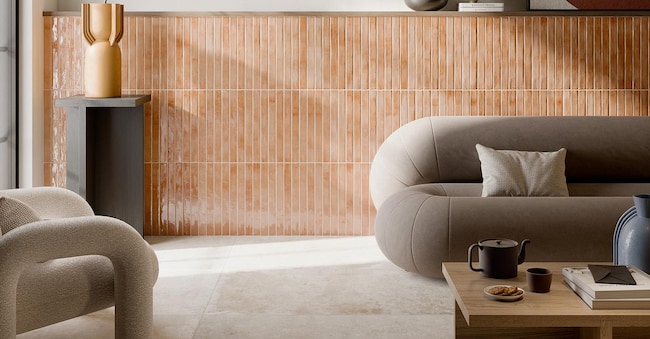
"Compared to the immense quantities of ceramics produced worldwide, the task of the Italians is to draw the line that the global ceramics sector will follow in the coming months and years," explains Stefano Bolognesi, president of Cooperativa Ceramica d'Imola. "This today mainly translates into a focus on material textures. I am thinking of tiles with three-dimensional effects, soft, textured glazes that add depth and visual interest."
Italian technological research focuses on tactile experience: the knots of the various wood essences, the graininess of concrete, the irregularity of slate and travertine, the texture of fabric. "The concept we work on, and have invested in from a production point of view, is to reproduce imperfection, in a controlled way," adds Alessandro Fabbri, managing director sales & marketing at ABK Group. "We apply processes that give depth to porcelain stoneware and result in ceramic slabs that mimic the structure of jute or in which the vein of marble continues in rib and bas-relief, as if sandblasted. They are so natural that they look like a patina of time; this has freed the ceramic slab from an aesthetic prejudice of designers, who for a long time did not consider it suitable for particularly prestigious contexts".
If, by their very nature, wood or stone can present unique irregularities and veins, the industry's answer is "to provide so many different faces per product type," explains Martina Romani, head of marketing at Gruppo Romani. "We produce an average of 15 declinations per model, with realistic colours and fibres that can be combined to create effects that, to the eye, are indistinguishable from the real thing."

